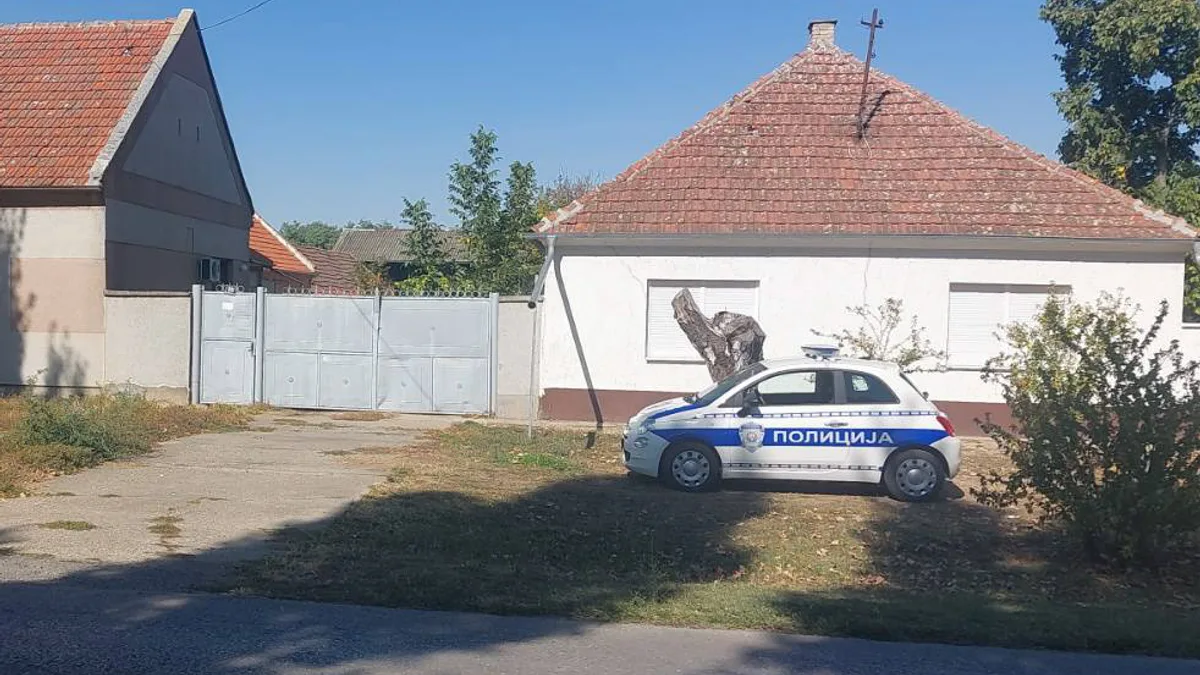
Fake Police Rob Family of 200,000 Euros in Novi Becej
Five masked men in police uniforms broke into a family home in Novi Becej, pointed guns at the household including children, and made off with about 200,000 euros and a kilogram of gold in roughly twelve minutes.

- Five masked men in police uniforms broke into a family home in Novi Becej.
- They took about 200,000 euros and a kilogram of gold, money the owner had set aside to buy a house.
- There were six children in the house, and a gun was held to the head of one child.
- The raid lasted only about twelve minutes, and the robbers later burned their getaway car.
Details of a robbery in Novi Becej have only now come to light. According to the investigation, five armed men broke into a family home in the wider town center in late June. They were wearing balaclavas and police uniforms. At first, the household believed real officers had arrived.
The confusion did not last long. The men drew pistols and pointed them at those present. Six children were in the house that evening. According to unofficial sources, the robbers held a gun to the head of one child and threatened to shoot if the family did not reveal where the money was.
The target of the raid was the family’s life savings. The homeowner, listed in the investigation by the initials S. S., has worked in Germany for years. According to reports, he had prepared around 200,000 euros to buy a house. Along with the cash, roughly a kilogram of gold was taken from the home.
How did the raid and escape unfold?
The whole break-in lasted, by reconstruction, only about twelve minutes. The robbers knew what they were after and moved quickly. Once they had gathered the money and gold, they left the house and got into a grey Audi A4. The car carried Austrian license plates issued in Vienna.
The escape was planned as precisely as the break-in. On the way out of town, the robbers removed the Austrian plates from the vehicle. On the outskirts of Zrenjanin, they set the car on fire. Burning a vehicle is a common method offenders use to destroy fingerprints, biological traces and other evidence that could link them to the crime.
The scene was deeply distressing for the family. This was a classic so-called film-style robbery, in which offenders use the false authority of a uniform to overcome their victims’ resistance. A uniform opens doors that would otherwise stay shut, and masks make later identification harder.
What is known about the investigation?
An investigation is underway against the accused. At this point, the identities of the suspects have not been made public, nor have details on whether anyone has been detained. No one’s guilt has been established by a final court ruling, and any mention of the perpetrators remains a matter of suspicion until the proceedings conclude.
For investigators, key leads usually come from several directions. The first is the vehicle. Even though the Audi was burned, a chassis number and other identifying data can still be recovered from a torched car. The second is the Austrian plates and the registration in Vienna, which raises the question of whether the offenders came from abroad or merely fitted the car that way.
The third direction is the method itself. Acquiring police uniforms, knowing the layout of the house and being aware of a large sum of cash inside all suggest the raid was probably not random. A question the investigation must resolve is whether the robbers had information from someone close to the family.
For now, only one thing is clear. In a matter of minutes, a family lost savings built over years of work abroad, along with the trauma the children endured. How long will these so-called film-style robberies keep paying off while offenders count on fear and the false authority of a uniform?