Saturn at Opposition on October 4, Brightest of 2026
Around 2 p.m. Serbian time on October 4, Saturn sits opposite the Sun, 1.26 billion kilometers from Earth, and stays visible from sunset to sunrise.
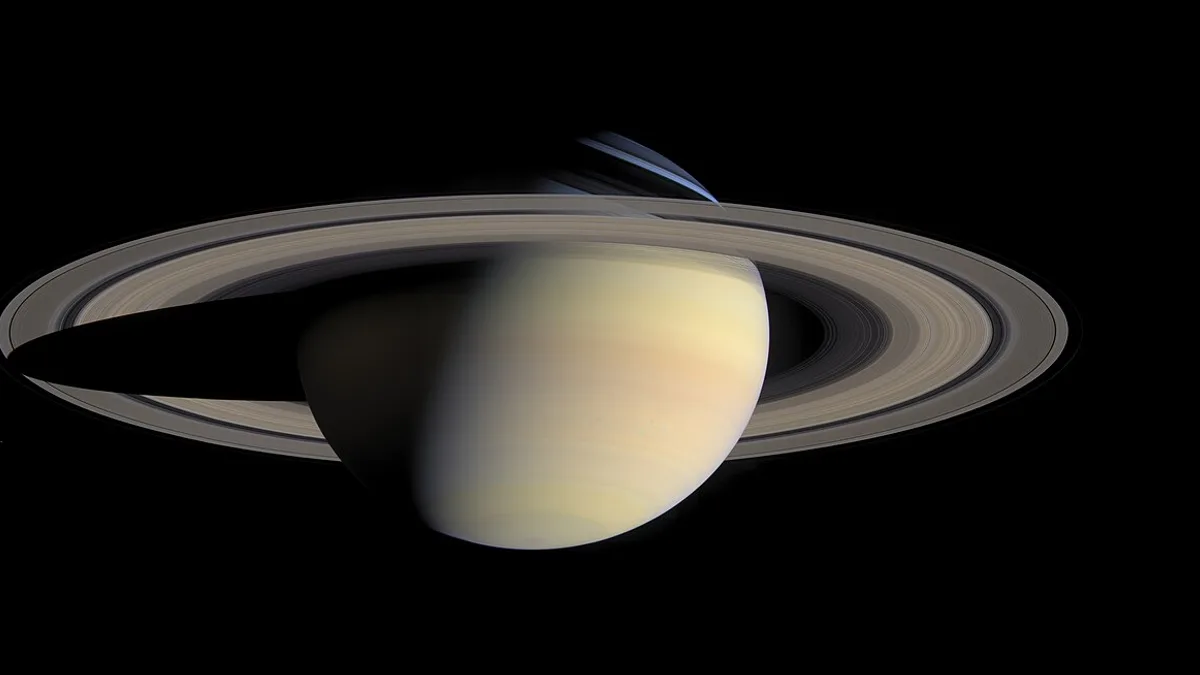
Saturn reaches opposition on Sunday, October 4, 2026. According to EarthSky, that happens at 12:00 Universal Time, or 2:00 p.m. in Serbia. The site When the Curves Line Up gives 7:29 a.m. Central Daylight Time, which is 2:29 p.m. in Serbia. The planet is then on the opposite side of the sky from the Sun, so it rises in the east as the Sun sets and sets as the Sun rises. That makes it visible all night.
What is opposition, and how far away is Saturn?
Opposition occurs when Earth passes between the Sun and an outer planet. Saturn’s orbit takes 29.4 Earth years, so each year Earth has to travel a little more than a full lap to catch up with it again. As a result, oppositions are about 378 days apart and fall roughly two weeks later each year. The previous one was on September 21, 2025, and the next is on October 18, 2027.
According to EarthSky, Saturn is 1.26 billion kilometers from Earth at the moment of opposition (784 million miles, or 8.43 astronomical units). Light from it takes about 70 minutes to reach us. The planet’s apparent disk is largest right around opposition, at 19.7 arcseconds across.
How bright is Saturn, and where do you look?
At opposition the planet shines at magnitude +0.3, its highest of 2026, and EarthSky and Phys.org agree on that. Phys.org also explains why it is a little brighter than usual: just before opposition the Seeliger effect, also called the opposition surge, kicks in. From our vantage point the planet looks almost fully lit, so, as with the Moon near full phase, most shadows between particles vanish, and the rings add a boost of about 0.3 magnitude. For a naked-eye comparison, Phys.org suggests the stars Capella and Rigel, both of magnitude zero.
Saturn lies in the constellation Cetus. Phys.org adds that it sits only at the very corner of that constellation, which is not part of the zodiac. Its motion is retrograde, an optical effect: as Earth overtakes the more distant planet, the line of sight shifts westward against the background stars. If you compare it with neighboring stars through binoculars from week to week, you can follow that motion until December 10.
According to When the Curves Line Up, conditions are best from about two hours after sunset to two hours before sunrise, when the planet is high above the murky layer of atmosphere near the horizon. Two hours after sunset, Saturn is about 20 degrees above the east-southeast horizon, a figure calculated for Chicago. Around midnight it is high in the south. It stays in the evening sky through the end of 2026 and disappears into the twilight glow in March 2027.
What can you see with binoculars, and what with a telescope?
You cannot see the rings in binoculars, but a good pair, held steady or mounted on a tripod, will show Saturn as a bright oval disk. Any small telescope shows the rings, and through one you can also make out the planet’s southern hemisphere.
The sources give different figures for the tilt of the rings: Phys.org says 12 degrees, EarthSky 7.5 degrees toward the south, and When the Curves Line Up about 10 degrees. Phys.org and EarthSky agree that the rings are opening up again after appearing edge-on in 2025. EarthSky mentions Earth’s passage through the ring plane in March 2025. The third site gives only the tilt. According to Phys.org, the rings will be at their widest in 2031.
Phys.org also advises looking for so-called spokes, radial dark streaks across the rings that are attributed to meteoroid impacts. Phys.org presents them as a feature worth watching for after last year’s equinox season on Saturn.
The Moon covers Jupiter on October 6
Two days after opposition comes an occultation of Jupiter. On Tuesday, October 6, around 10:16 Universal Time, the Moon, a waning crescent 20 percent lit, will pass in front of Jupiter. Phys.org says the event is visible from the eastern United States and Canada before dawn, and according to independent sources the visibility zone also includes the northern Caribbean islands and West Africa. It cannot be seen from Serbia, where it will be about 12:16 p.m. The next good occultation of Jupiter for the eastern United States will not come until September 28, 2034.
What this does not tell us
The sources differ on the moment of opposition by about half an hour and on the ring tilt by a few degrees, so none of those numbers should be treated as the single correct one. The moment of opposition falls around 2 p.m., when it is daytime in Serbia, so the planet can only be observed on the night of October 4 to 5. The figures for distance, brightness and apparent diameter come from one source, EarthSky, and Phys.org confirms them for brightness. This is a forecast, not the result of an observation.