Spacewalk Oct. 29: Seventh Solar Array for Space Station
NASA announced two spacewalks, Oct. 29 and Nov. 5, to finish installing eight IROSA arrays and raise the station's power from 160 to about 215 kilowatts.
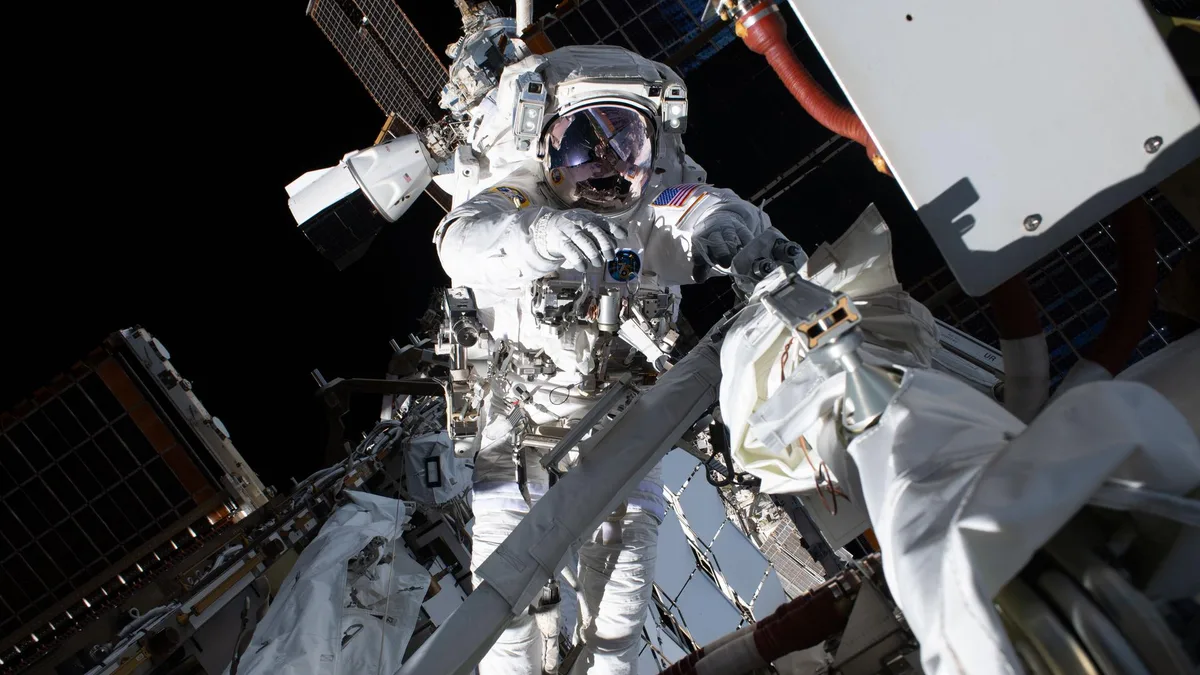
NASA astronaut Anil Menon and Canadian Space Agency astronaut Joshua Kutryk will leave the Quest airlock on the International Space Station on Thursday, October 29, 2026, and again on Thursday, November 5. Their goal is to install the last two solar arrays and complete the station’s power upgrade. NASA presented the spacewalks on October 20 at a media briefing at Johnson Space Center in Houston.
What happens on the first and second spacewalk?
The first outing is designated U.S. spacewalk 100. Menon and Kutryk will install and unfurl the seventh IROSA (ISS Roll-Out Solar Array, a flexible panel that unrolls in orbit) on power channel 2A. The second, number 101, puts the eighth and final array on channel 3B. By NASA’s count, these are the 285th and 286th spacewalks for assembling, maintaining and upgrading the station.
An IROSA is thin and flexible. It mounts in front of one of the station’s original wings and partly covers it. The first arrays of this type reached the station in 2021.
How much power do the arrays add?
According to NASA’s statement, all eight arrays together raise available power by up to 30 percent, taking the station’s generating capacity from 160 to about 215 kilowatts. Gaurang Patel, operations integration manager in the low Earth orbit program, said at the October 20 briefing that the arrays “increase our power generation capability up to 30 percent.”
The two NASA figures do not match exactly. The gap between 160 and about 215 kilowatts is roughly 55 kilowatts, or about 34 percent. That is our own calculation, not a number from the statement, and none of the coverage we read explains the difference. The extra power is also needed for the safe, controlled deorbit of the station, currently planned for 2030.
How did the arrays reach the station?
The arrays arrived on a cargo Dragon for mission CRS-35, which launched from Cape Canaveral on October 13 and docked with the Harmony module on October 15. According to SpaceQ, it carried more than 2,850 kilograms (6,300 pounds) of food, supplies and research equipment. The Canadarm2 robotic arm removes the arrays from the Dragon’s trunk and parks them on the station truss. During the spacewalks it also serves as a platform for one of the two astronauts. Canadian astronaut Chris Hadfield helped attach that arm to the station in April 2001, on the first Canadian spacewalk.
On October 20, Menon prepared tools and inspected tethers in the Quest airlock for both spacewalks. NASA will announce exact start times closer to the dates. Menon has already been outside once, on August 6, when he prepared the right side of the truss for one of the new arrays.
Who is Kutryk, and why does this matter for Canada?
Kutryk arrived at the station on October 1, 2026, aboard Crew-13, on his first spaceflight, and will stay about six months. He will be the fifth Canadian astronaut to work outside the station, after Hadfield, Steve MacLean, Dave Williams and David Saint-Jacques, and the first since Saint-Jacques’ spacewalk in April 2019.
What this does not tell us
The spacewalks are planned for October 29 and November 5 and have not happened yet, so the outcome is unknown and the dates could slip. NASA ties the 30 percent figure to all eight arrays together. The sources do not say how much of that gain comes from the last two arrays, or how much the station will produce after each individual spacewalk.