Magnetic dynamo drives superflares on star KIC 2852961
A Budapest team says the red giant's flares come from its own magnetic activity, while its companion acts only indirectly, through tidal forces.

In brief
- Star: the red giant KIC 2852961, about 12 solar radii across, in a binary system with a faint dwarf star
- Finding: the superflares are driven by the giant’s internal magnetic dynamo, not directly by its companion
- Paper status: submitted to Astronomy & Astrophysics, and sources disagree on whether it has been accepted
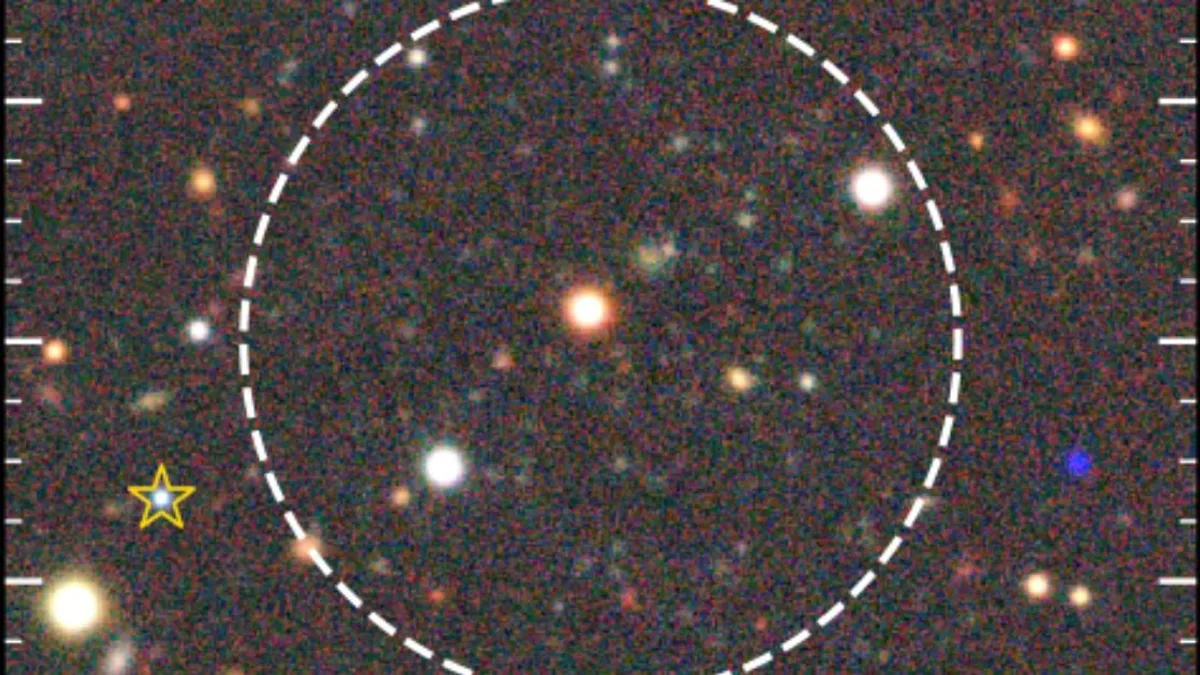
A team at the Konkoly Observatory in Budapest, part of the HUN-REN CSFK research centre, has explained why the red giant KIC 2852961 produces the strongest flares in the entire field observed by NASA’s Kepler space telescope. The lead author is Zsolt Kovari, and 14 authors are listed on the paper, among them K. Olah, K. Vida, L. Kriskovic and B. Seli. The paper was posted to arXiv on October 8, 2026, and the public learned of it on October 21, when Phys.org covered it.
A superflare is an explosive release of magnetic energy on a star, strong enough to exceed even the biggest flares the Sun can produce. In 2020 the same team cataloged 59 confirmed flares from this star in the full Kepler dataset, in a paper in Astronomy & Astrophysics, with energies from 10³⁵ to 10³⁸ ergs (10²⁸ to 10³¹ joules). They concluded then that flares and superflares on very different stars probably share the same physical mechanism. The new paper asks something more specific: what drives the flares on this particular star?
“We wanted to find out what makes this particular star so extreme.”
That is how Kovari described the starting point of the research to Phys.org.
What do the new measurements show?
The authors combined ground-based spectroscopy, Kepler photometry and data from the European Gaia mission. Radial velocity measurements confirmed that KIC 2852961 is the primary component of a close binary, and that its companion is a faint dwarf star.
The companion’s tidal forces began to act once the star swelled into a red giant. The time needed to circularize an orbit grows with the ratio of the separation to the star’s radius raised to the eighth power, so forces that were negligible on the main sequence became very effective once the star grew to its present size of about 12 solar radii. As a result, the system is nearly, but not perfectly, tidally locked: the giant’s rotation almost matches the orbital motion.
That “nearly” matters. Stars do not rotate as rigid bodies. Different latitudes turn at different speeds, which is called differential rotation, and on the Sun the equator rotates faster than the poles. In KIC 2852961 the tides have strongly limited differential rotation without eliminating it, and what remains powers a magnetic dynamo, the process by which a star continually generates and amplifies its own magnetic field.
“Differential rotation plays a dual role.”
Kovari summed it up that way. According to the authors, differential rotation sustains large starspots on the surface and at the same time twists and shears the magnetic field lines of the corona above them. When those strained lines reconnect, a superflare results.
Why doesn’t the companion trigger the flares directly?
The obvious assumption was that a close companion sets off flares by linking the magnetic fields of the two stars. The team checked whether flares cluster at particular phases of the orbit and found no such dependence. The authors therefore conclude that the companion plays an indirect role: by speeding up the giant’s rotation through tides, it created the conditions for an efficient dynamo.
In this picture, large dark spots are reservoirs of magnetic energy. The brightness of KIC 2852961 varies strongly as the star rotates, and that variation comes from spots covering a large part of the surface. The more of the surface they cover, the more energy is available for a flare, so the paper supports a close link between spot size and flare energy.
What does this not prove?
The paper analyzes a single star, so it does not show that the same mechanism lies behind flares on other red giants in binary systems. The absence of any dependence on orbital phase means direct triggering was not seen in this data, not that it has been ruled out in every other system. The status of the paper is also unclear: Phys.org says it has been accepted by Astronomy & Astrophysics, while arXiv says only that it was submitted to the journal after revisions requested by reviewers. Until peer review is officially complete, the findings should be read as preliminary.