Star cluster VVV CL001 is 13.4 billion years old
A team of astronomers at INAF Capodimonte Observatory estimates that the cluster behind dense dust near the Milky Way's center is among the galaxy's oldest. Confirmation is still to come.
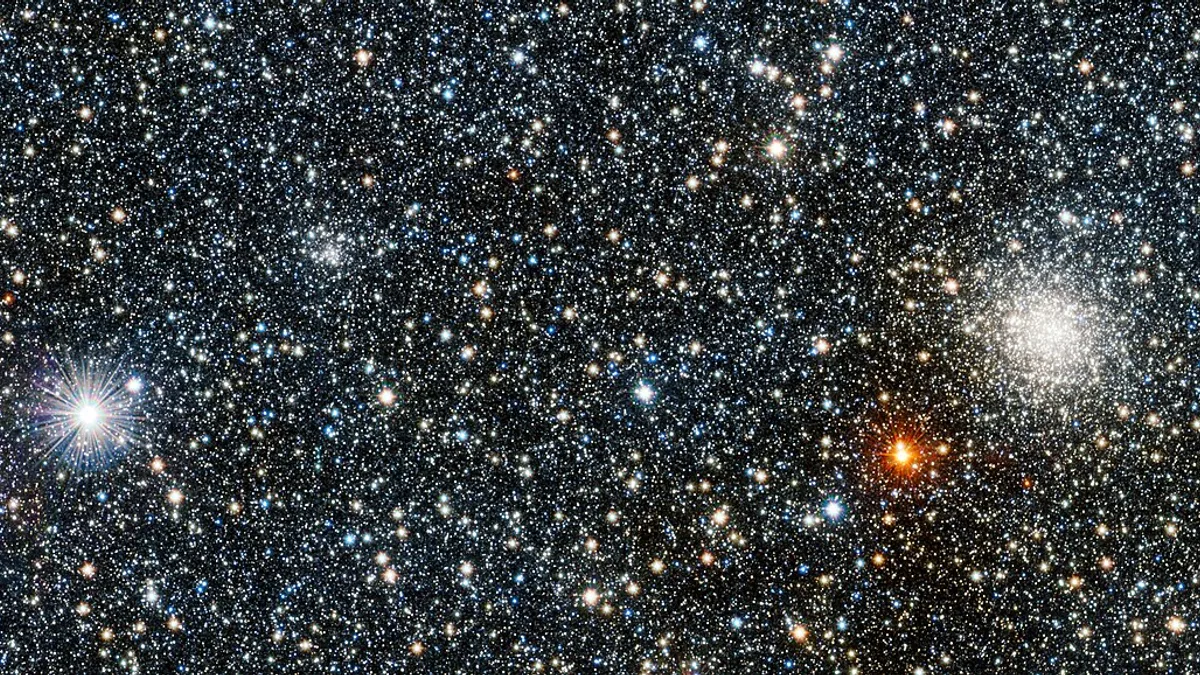
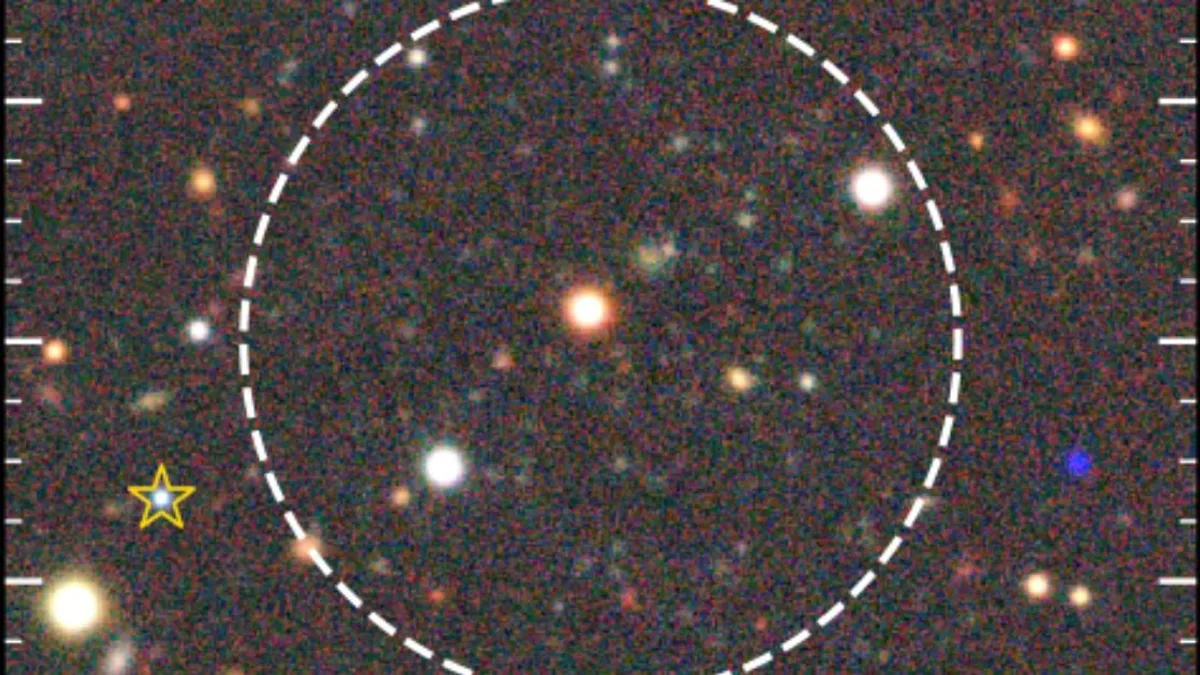
The star cluster VVV CL001 in the constellation Sagittarius is 13.4 ± 0.4 billion years old, according to a team of astronomers that posted a paper to the arXiv server on October 20, 2026. The study was led by J. Olivares Carvajal of the INAF Capodimonte astronomical observatory, and the paper has been accepted for publication in Astronomy & Astrophysics. The authors conclude that it is one of the oldest clusters in the Milky Way.
What is VVV CL001, and why is it hard to measure?
It is a globular cluster, a dense, roughly spherical group of old stars, that lies close to the center of the galaxy and is hidden behind thick interstellar dust. It was found in the VISTA Variables in the Via Lactea (VVV) sky survey. Phys.org reports that it was discovered in 2010 and confirmed as a cluster in 2019.
The dust dims the light, the cluster is small and faint, and earlier images were not deep enough to show enough of its stars. RR Lyrae stars, which astronomers usually rely on to measure distance, have not been found in it. That is why earlier distance estimates disagreed, and the cluster’s orbit around the galaxy depends on the distance.
An earlier estimate from 2021 gave an age of 11.9 billion years, with an uncertainty of +3.12 to -4.05 billion years, and a distance of 8.22 kiloparsecs (about 26,800 light-years). It was not the only estimate in the literature, but it shows how wide the range was.
How did the team arrive at 13.4 billion years?
For distance, the authors used a deep infrared image from the FourStar camera on the 6.5-meter Magellan Baade telescope. For age, they relied on Hubble Space Telescope images, where dust interferes less. They separated cluster members from surrounding stars using their motion across the sky and the HDBSCAN machine-learning algorithm. That singled out about 155 stars, among them stars in the horizontal branch and turnoff phases that had not been spotted in this cluster before.
The turnoff point is the moment a star stops burning hydrogen steadily in its core, and its position on the diagram is the best indicator of a cluster’s age. Horizontal branch stars have a constant brightness, so they serve as a distance marker.
The result is a distance of 7.34 ± 0.46 kiloparsecs, about 24,000 light-years, which the authors call the most precise measurement so far.
“Our result also has the smallest distance error recorded in the literature to date,” the authors wrote in the paper.
The age was derived in two ways, once from the Hubble images and once from stars around the turnoff point. Both methods give the same result. The authors, led by Olivares Carvajal, state in the paper:
“Both methods estimate the age of the cluster at 13.4 ± 0.4 billion years.”
The team also says it found a “significant number of new cluster members.”
What does that age mean for the galaxy?
The universe is estimated to be about 13.8 billion years old, so a cluster’s age has to fall below that limit within the uncertainty of the measurement. The upper bound of the VVV CL001 estimate, 13.4 plus 0.4, touches that value.
According to the authors, the cluster is probably the most metal-poor in the galaxy’s central bulge, with [Fe/H] around -2.2. Its orbit places it in that bulge, which the authors link to the earliest phase of the Milky Way’s formation. If the cluster formed there and is as old as they claim, estimates of the galaxy’s own age would need to be revisited.
A physical pairing with the nearby cluster UKS 1 is also possible, but it has not been established whether the two clusters are gravitationally bound or simply have similar radial velocities.
What does this paper not prove?
The authors call it a strong candidate for the oldest cluster in the galaxy, not a confirmed record holder. A sample of about 155 stars and an uncertainty of ±0.4 billion years leave room for a different outcome. The estimate rests on stellar evolution models, and confirmation from the cluster’s chemical composition is still to come: the team plans high-resolution spectroscopic follow-up.
For now the paper is a preprint accepted for publication, and no independent replication of the measurement exists. The object was confirmed as a cluster only in 2019, so it is reasonable to expect the numbers to shift again.