

Hera Reaches Didymos: First Approach Maneuver Nov. 4
Europe's Hera probe begins its first close approach to the asteroid pair hit by NASA's DART in 2022 at 2 a.m. Belgrade time tomorrow, according to a schedule published by Orbinauts.
The European Space Agency (ESA) expects its Hera probe to reach the double asteroid Didymos and Dimorphos in November. The first close-approach maneuver, designated ECP-1, is scheduled for November 4, 2026, at 01:00 Universal Time, which is 02:00 in Belgrade, according to a schedule published by the site Orbinauts. The maneuver begins the initial survey of the system.
The probe will not enter a permanent orbit. Under the same plan, it will pass by the asteroids in a series of hyperbolic arcs. The German outlet Heise reports that it will observe them first from a safe 25 to 30 kilometers, then move in to 10, 4 and finally 1 kilometer. Hera is operated by ESA’s European Space Operations Centre in Darmstadt.
What has Hera done so far?
The probe launched on October 7, 2024, and flew past Mars in March 2025. As early as October 2025, ESA announced that a new, more aggressive braking schedule, later and stronger, would bring the probe in a month earlier than originally planned. Sylvain Lodiot, ESA’s head of operations for outer Solar System missions and planetary defense, said at the time:
“This will allow Hera to reach the asteroid a month earlier than we originally planned.”
Earlier this October, Hera fired its engines twice, a week apart, and slowed to 20 meters per second relative to both asteroids. On October 23, citing the mission team, Orbinauts reported that the second braking burn lasted about 31 minutes and cut the speed by about 70 meters per second, when the probe was roughly 2,300 kilometers from the system.
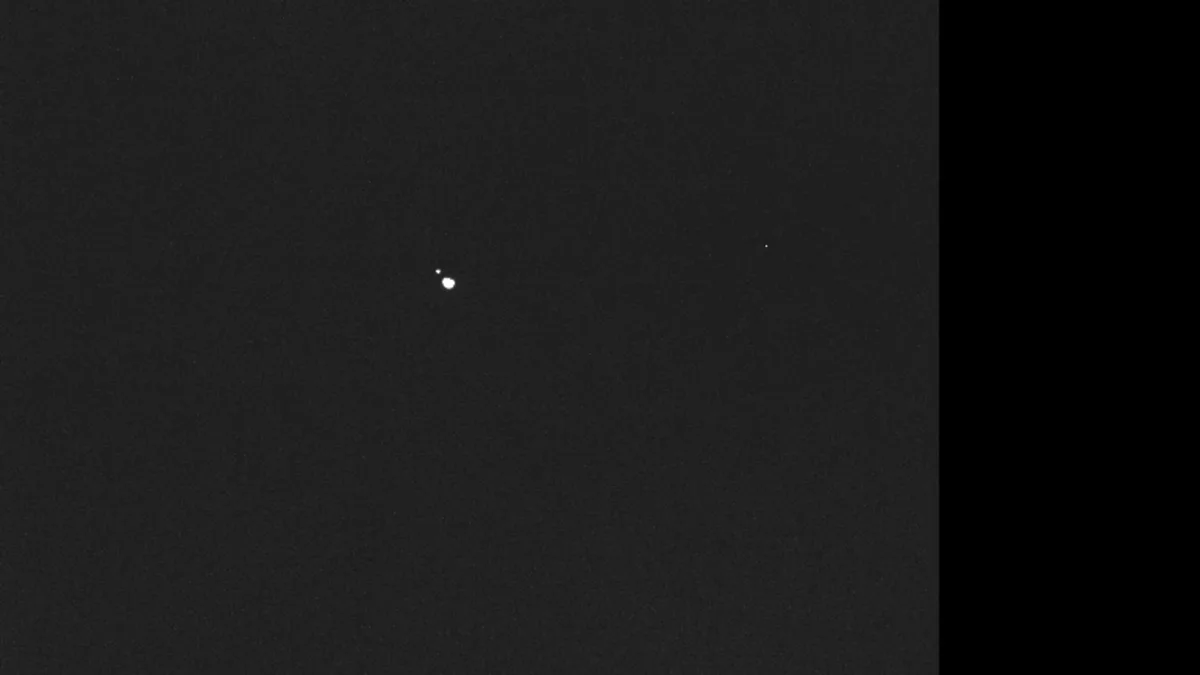
On the evening of October 18, from 1,280 kilometers away, the black-and-white Asteroid Framing Camera took the first image in which the two asteroids appear separately. ESA published it on October 27. Until then, the system had been a single point to the probe. Michael Kueppers, an ESA scientist on the mission, said in a statement:
“With this image, the smaller asteroid Dimorphos becomes visible for the first time. Before this image was taken, the spacecraft still resolved the Didymos system as a single point. Now, although Dimorphos makes up only about one pixel in this initial image, it is clearly separated from the parent body.”
Ian Carnelli, ESA’s Hera mission manager, added: “For the first time we are seeing with Hera’s own eyes the very double asteroid system that this mission was designed and built for.” He said the view will get sharper as the probe closes in, and that ESA will release the first detailed images of Dimorphos on November 25.
What is Hera looking for at Dimorphos?
The pair is about 197 million kilometers from Earth. Didymos is about 780 meters across and Dimorphos about 151 meters, roughly the size of the Great Pyramid of Giza. The average distance between them is 1.15 kilometers, and Dimorphos circles the larger body at about 18 centimeters per second.
The American DART probe struck Dimorphos on September 26, 2022, at 6.1 kilometers per second. The impact threw material 10,000 kilometers into space and shortened Dimorphos’s orbit around Didymos by about 33 minutes, considerably more than simulations had predicted.
What the impact did to the asteroid itself remains an open question for ESA. Scientists want to know whether a crater formed or the body was reshaped, and they also want more precise data on its composition, internal structure and mass. The probe also carries two shoebox-sized satellites. Juventas will use radar, with a resolution of about 10 meters, to probe the interior of Dimorphos, while Milani will study its mineral makeup. According to Heise, the satellites should be released in early 2027, and one of them is expected to land on Dimorphos.
None of these questions has an answer yet. The only image so far shows Dimorphos as a single pixel, so everything said about craters and shape is still a goal of the mission, not a result. Observations on site will continue over the coming months.


