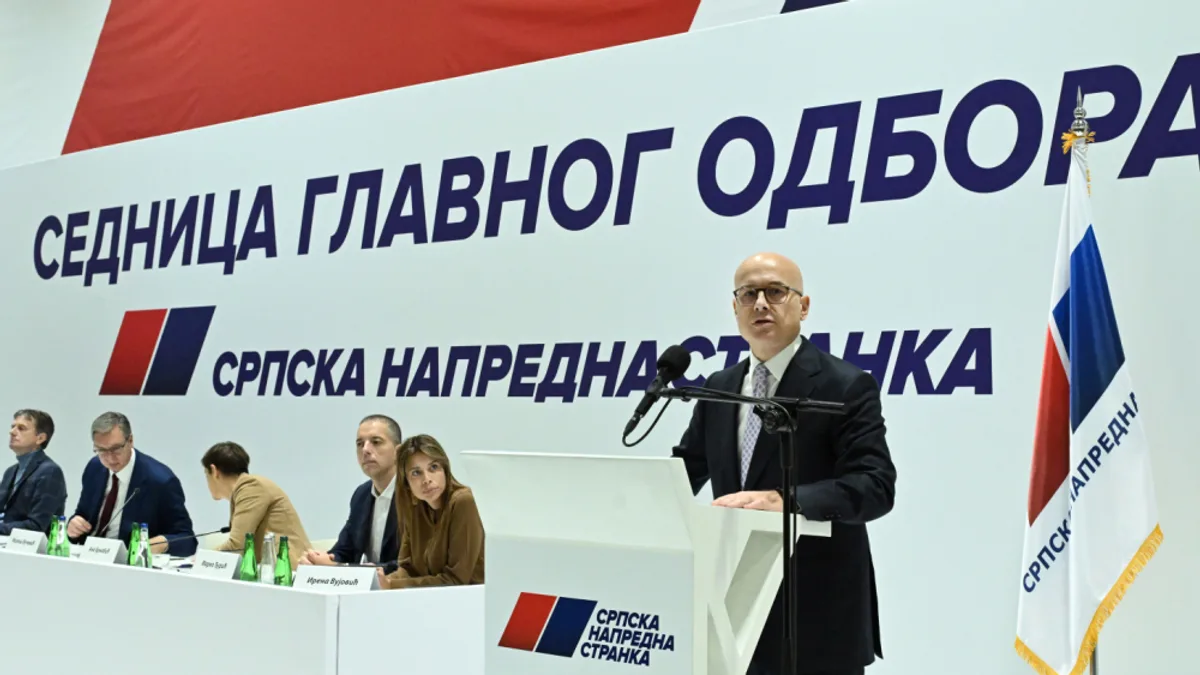
Vucic says blockade support is fading, rejects early vote
The president claims support for the blockades is declining daily and refuses to call an early election under pressure, while the opposition, analysts and part of the media argue the movement is not weakening.

- President Aleksandar Vucic claims support for the blockaders is falling every day and refuses to call an early election under pressure.
- Government figures describe the blockades as serious crimes, and Milos Vucevic has branded them terrorism rather than civil disobedience.
- Vucic promises a margin at the polls so wide that opponents, he says, will have nothing to object to.
- Analysts, the daily Danas and Russia's Kommersant dispute the claim of fading support and argue the government fears a vote.
President of Serbia Aleksandar Vucic has repeated in recent days that support for the blockaders is declining daily, and flatly refused to call an early election under pressure from the street blockades. He described the blockades as serious criminal acts, insisting that the state’s decisions will not be made under coercion.
With that, the president further sharpened the narrative the government has been building for months. Milos Vucevic backed him, saying the blockades in Serbia amount to terrorism rather than civil disobedience and claiming that a minority is disrupting the lives of the vast majority of citizens. On the other side of the divide stand the opposition, the student movement and a section of analysts who argue the opposite, that the movement is nowhere near as weakened as the government portrays.
What exactly is the president saying
Vucic announced that the margin at the coming election will be so large that his opponents will have nothing to say. The message works two ways. On one hand it is the usual pre-election show of confidence. On the other, the president also claimed that the ground is already being prepared to contest the result, disqualifying in advance any objections to the fairness of the vote.
Refusing to tie the election to pressure from the street is a carefully chosen move. Calling an early election is precisely the central demand of the opposition and the students, so any concession at this moment would be read as an admission that the blockades are working. The government avoids that, insisting the electoral cycle is a matter of its own judgement rather than a consequence of the demonstrations. Within the ruling coalition there is already talk of a timeframe of several months, but without a single firm commitment.
The language about serious crimes and Vucevic’s mention of terrorism are not mere rhetoric. They set a legal frame in which the protest is treated not as a political act but as a security threat, leaving the authorities room for a tougher institutional response.
Is support really fading
This is where the government and opposition narratives collide most sharply. The daily Danas and some analysts judge that the movement still stands strong and that the claim of eroding support has no basis in what can be seen on the streets. Russia’s Kommersant went a step further, assessing that Belgrade is slipping out of obedience and that the government, despite its public confidence, in fact fears going to the ballot box.
Neither side offers measurable proof for now. The government invokes a daily drop in support without published figures, while the opposition measures the movement’s staying power by the size of the crowds and the length of the blockades. In such a clash of perceptions, an election remains the only mechanism that would put both claims to the test, and that is exactly what the fight is about.
What is certain is that the stakes are rising. By refusing an election under pressure, the government has placed itself in a position where it must win convincingly whenever the vote is called, since a narrow result would be read as confirmation of the opposition’s case. The opposition, for its part, must show that the gatherings are not merely a picture for the cameras but an electorate that converts into votes.
Do you believe an early election will be called this year, and in your view which side is favoured by the numbers no one has yet published?