Serbia prints 6,450,523 ballots for October 25 election
Printing of the ballots has begun at the Sluzbeni Glasnik print shop. Voters will cast ballots at 8,392 polling stations, and each ballot carries 18 electoral lists in 29 language variants.
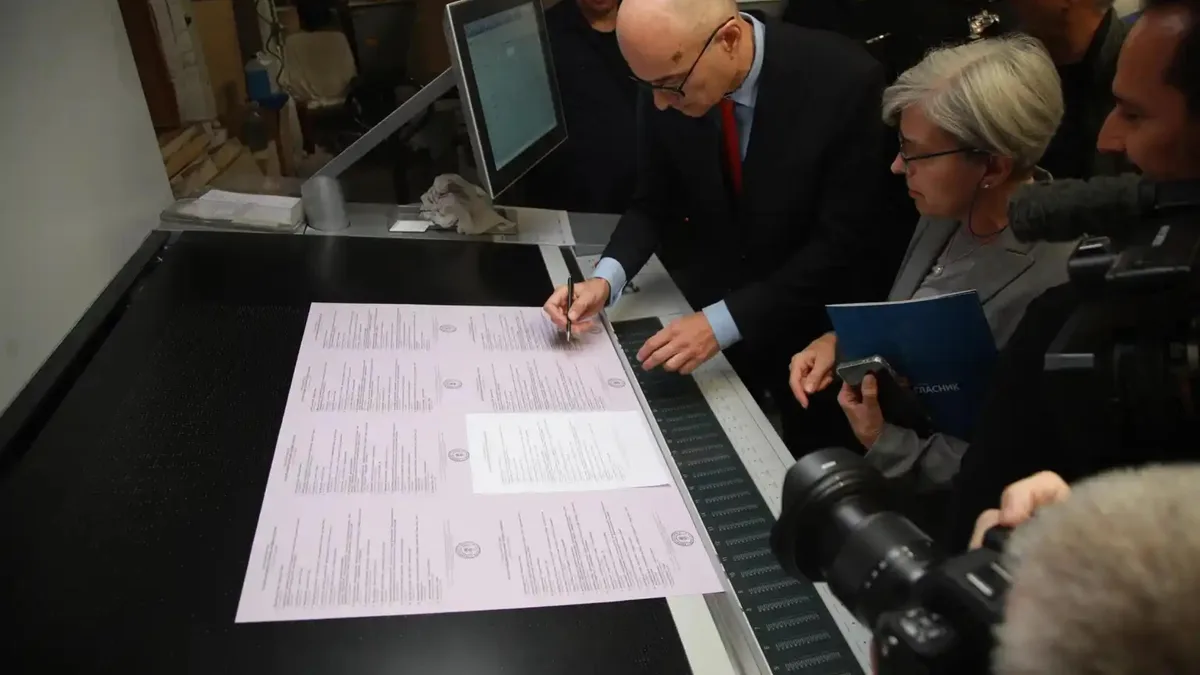
The Republic Electoral Commission (RIK) began printing ballots on Monday, October 12, for the parliamentary election called for October 25, 2026. The work is being done at the print shop of the public company Sluzbeni Glasnik, and 6,450,523 ballots are being printed, exactly the number of voters entered in the register as of October 9.
According to the RIK announcement, printing was scheduled to start at 12:00. Commission chairman Vladimir Dimitrijevic, RIK members and accredited observers attended, and the Commission’s statement also lists media representatives.
How was the number of ballots decided?
RIK published the decision on the total number of voters on Saturday evening. At a session on October 10 it also determined that as many ballots would be printed as there are voters. Dimitrijevic repeated this at the event itself:
The number of ballots to be printed is equal to the total number of voters in Serbia as of October 9, 2026.
Asked by a journalist how he explains that the number of voters is almost equal to the number of citizens of Serbia, Dimitrijevic said RIK is guided solely by the decision of the Ministry of Public Administration and Local Self-Government on closing the voter register.
How many polling stations are there, and where?
Dimitrijevic said voting will take place at a total of 8,392 polling stations. Of these:
- 93 are abroad, in 37 countries
- 29 are in institutions for the enforcement of criminal sanctions
- 60 are designated for voters from the territory of Kosovo and Metohija, in Vranje, Kursumlija, Raska and Tutin
What is on the ballot, and how is it printed?
The ballot carries 18 electoral lists, in the order in which they appear on the Consolidated Electoral List that RIK adopted on October 8. Nine of them hold the status of an ethnic minority list, according to B92 and Una. The ballot is purple and is printed on watermarked paper, while the control sheet used to check the ballot box is white.
Because of the languages in official use in certain municipalities, the ballots come out in 29 variants. Dimitrijevic explained it this way:
The ballots will be printed in 29 language variants, depending on which languages and scripts are in official use in individual municipalities and cities in Serbia.
The format depends on the number of languages: A4 for a ballot in Serbian only, A3 for two or three languages, and A2 for four or five languages or scripts. Representatives of the submitters of electoral lists, as well as domestic and foreign observers, have the right to follow the printing, counting and packing of the ballots, and their delivery to commissions and polling boards.
When does the material have to arrive?
After printing and packing comes the handover, and Dimitrijevic laid out the deadlines this way:
After printing and packing comes the handover of the election material, which the coordinators of the Republic Electoral Commission will deliver to the local electoral commissions no later than four days before election day. The local commissions then hand the material over to the polling boards, no later than the end of October 23.
Counting back from October 25, RIK coordinators have until October 21 to hand the ballots to local commissions, and local commissions must hand them to polling boards by October 23.
Dimitrijevic also said what the schedule is meant to achieve: “The point is that the complete election material, including the ballots, reaches the polling boards on time, so that everything is ready for the opening of the polling stations on election day, October 25.”