Russia Hits Kyiv with Missiles and Drones, Hospital Damaged
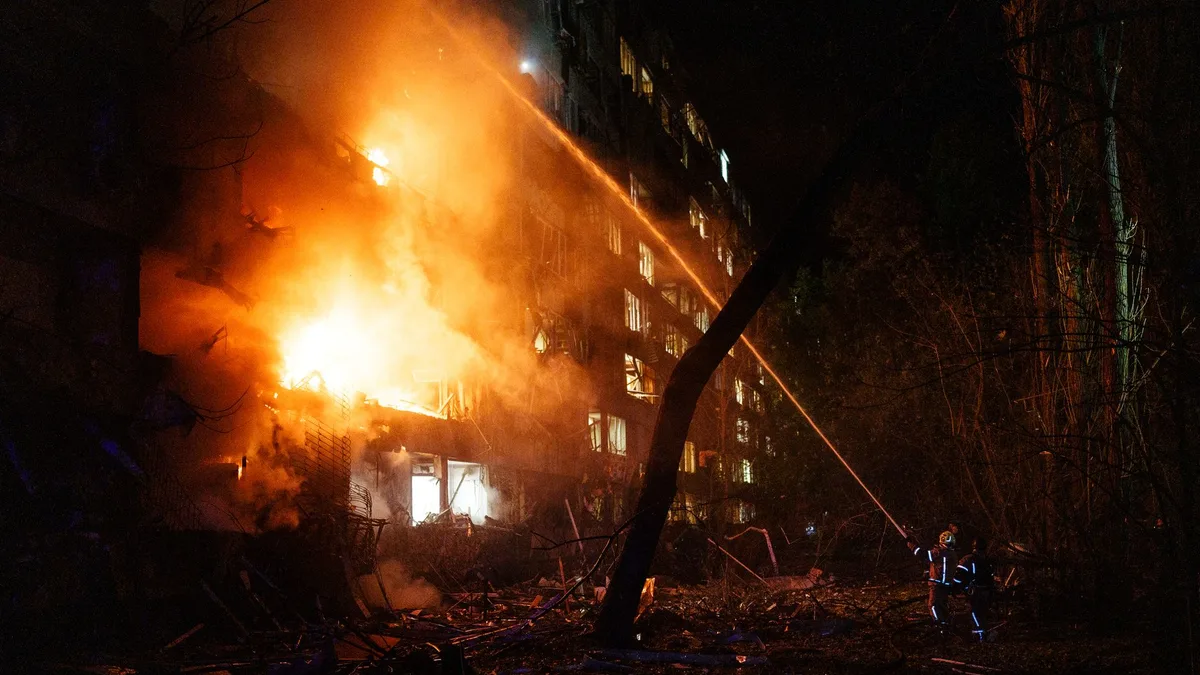
Russia struck Kyiv overnight on August 19 and 20 with missiles and drones, damaging a children's hospital and homes. Death tolls vary by source, with a day of mourning set for tomorrow.

Russia carried out one of its longest attacks on Kyiv in recent weeks overnight between August 19 and 20, striking the capital for hours with missiles and drones, damaging a children’s hospital building and leaving the city marking a day of mourning the following day. For Belgrade, which has spent years balancing its European integration path against traditional ties to Moscow, every escalation of this scale narrows the room for foreign policy maneuvering further, as Brussels pushes ever more openly for candidate countries to align their foreign policy with the sanctions regime. That same night, Poland’s air force had to scramble fighter jets to protect its own airspace, a sign that the war has long since spilled beyond Ukraine’s borders and now touches the security architecture of the entire continent.
The attack began shortly after midnight on August 20, according to Ukraine’s Kyiv Independent and America’s ABC News, with a new wave of explosions following at 6:17 a.m. A brief all clear was announced at 8:36 a.m., but roughly half an hour later a new alert followed, this time over incoming Banderol type missiles approaching the city. Ukraine’s air force said missiles and drones hit 28 locations in Kyiv and the surrounding area in total.
How Many Weapons Were Launched, and How Many Were Shot Down?
According to Ukraine’s air force, Russia fired an unspecified number of ballistic missiles, 44 cruise missiles, two Banderol missiles and 168 Shahed type drones. ABC News, citing the same source, put the figures at 46 cruise or air to surface missiles and 168 drones. Ukrainian officials said they shot down or neutralized 39 cruise missiles, both Banderol missiles and 145 drones, while ABC reported 41 cruise missiles and 145 drones downed, 186 targets in total. Neither source reported any ballistic missile shot down, and Ukraine’s air force has not previously disclosed the exact number of ballistic missiles launched or intercepted.
Part of the attack, according to Euromaidan Press, also involved hypersonic Zircon missiles and Kalibr cruise missiles. The Kalibr missiles, launched from naval platforms, were confirmed to have been fired from the direction of Novorossiysk. Sources differ on where the Zircon missiles were launched from: the Kyiv Independent reports they were fired from the Kursk region, not from the direction of Novorossiysk.
What Was Hit in the Solomianskyi District
Kyiv’s Solomianskyi district took the worst of the damage. A children’s hospital building there was damaged, its windows blown out, while vehicles burned on the hospital grounds. The same district saw a five story residential building hit, and damage was recorded on another building between the eighth and ninth floors, where people were trapped in a shelter. Warehouses burned in the Sviatoshynskyi district, and non residential buildings were hit in the Darnytskyi district. The same night, strikes also hit the Odesa and Chernihiv regions.
Why Do Death Toll Figures Differ Between Sources?
In its first hours of coverage, the Kyiv Independent reported five people killed and 23 wounded. That figure was later revised to 13 to 15 dead. Ukrainian President Volodymyr Zelensky and ABC News give a different picture: at least 12 killed and more than 40 wounded. Outside Kyiv, one person was killed in Brovary, in the Kyiv region. Hospitals treated at least 14 wounded from the city itself. The discrepancy in the numbers reflects how much the reports shifted overnight and into the morning, as rescue crews kept working at the sites.
Kyiv Mayor Vitali Klitschko warned residents on social media during the attack.
Explosions in the capital. Kyiv is under ballistic attack. Stay in shelters.
He later announced that August 21 had been declared a day of mourning in the city.
Zelensky described the attack as premeditated and aimed at civilian infrastructure.
The attack was massive. The Russians prepared for a long time, combining different types of ballistic missiles, cruise missiles and drones, with the goal of causing as much damage as possible to civilian infrastructure.
Ukraine’s Foreign Minister Andrii Sybiha called it one of the most brutal attacks since the war began.
This was one of the most brutal Russian attacks so far, with ballistic missiles falling like rain.
The Interceptor Shortage and What It Means for the Region
The attack comes at a time when Ukraine, according to officials in Kyiv, faces a chronic shortage of interceptor missiles for its Patriot systems, the only system in Ukraine’s arsenal capable of shooting down ballistic missiles. Zelensky warned about this directly.
Interceptors for the Patriot systems are still not available, and they are needed every day.
Ukraine is developing its own missile defense system, called Freja, but according to officials in Kyiv cited by ABC News, it is not expected to become operational before 2027. For the region, including Serbia, attacks of this kind mean a further delay to any realistic prospect of a quick end to the conflict, and with it prolonged uncertainty over energy prices and the flow of goods through Eastern Europe, issues that spill directly into the domestic economy.
Earlier this week we reported on a missile strike on Pechenihy in the Kharkiv region that killed ten people, as well as on the postponement of a festival in Moscow after Ukrainian drone strikes. The attack on Kyiv overnight on August 20 is a separate event, the first of this scale aimed directly at the capital since we began following this string of escalations, and the declaration of a day of mourning in the city shows the scale of damage authorities have acknowledged.
That same morning, while crews in Kyiv were still clearing the aftermath, Ukrainian drones struck oil infrastructure on the Russian side, a refinery in Tatarstan and an oil terminal in Krasnodar Krai, continuing the campaign through which Kyiv has been responding with strikes on energy facilities. As of the latest reports, the attack on Kyiv was still being treated as ongoing, and the air raid alert in the capital remained in effect.