France halts stun grenades at student protests
The biggest day of protests drew at least 250,000 people, and Interior Minister Laurent Nunez stopped stun grenades after a 15-year-old in Lens lost a hand.
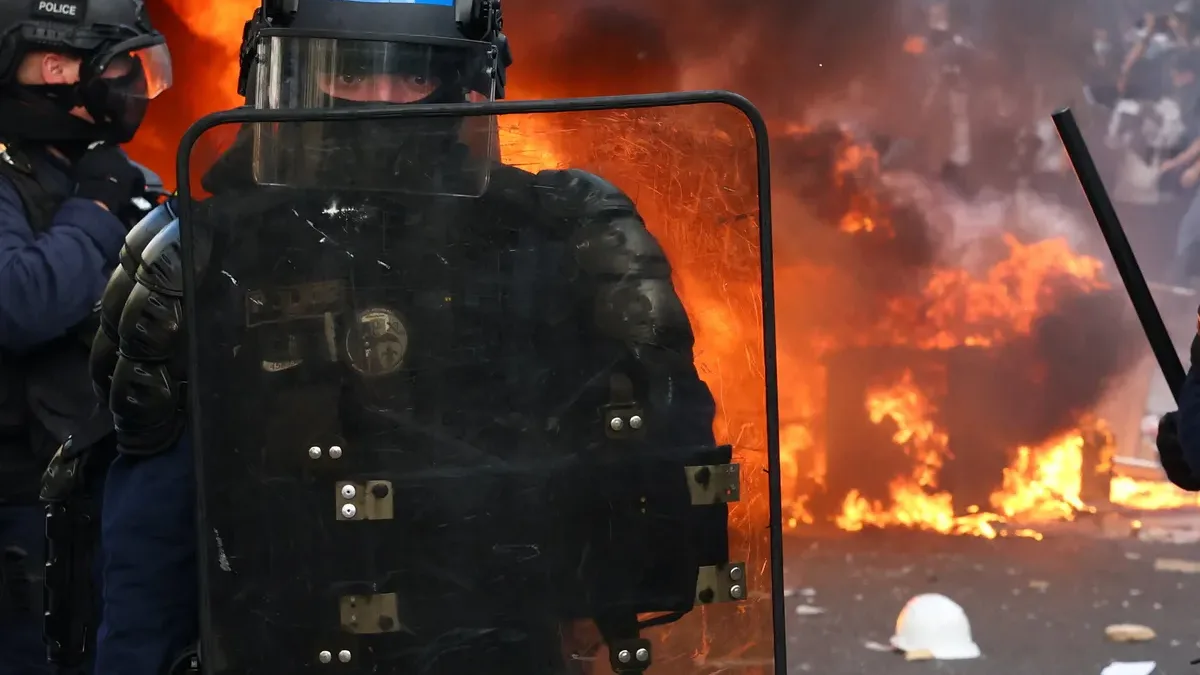
French police will no longer use stun grenades at high school protests, Interior Minister Laurent Nunez announced on Wednesday, October 7, a day after the biggest protest day since the movement began. The trigger was an injury to a 15-year-old in Lens, in the north of the country, who lost a hand on Monday, October 5.
Nunez justified the decision in a single sentence: the grenades are suspended “until we establish exactly what happened.” Authorities have not confirmed the circumstances, above all whether the boy picked up the grenade or was hit by it, but they say up to 200 demonstrators were throwing various objects at police when units moved in. N1, citing CNN, reports that the student lost his hand after allegedly picking up a grenade.
What does the injured boy’s mother say?
The 15-year-old’s mother said on Wednesday that her son’s hand was amputated and that he did not try to pick up the grenade. She told French media:
“His life has been stolen. He is a 15-year-old child, how can anyone treat children like this?”
Her account and the authorities’ version do not match, and the investigation that could settle it has yet to deliver an answer.
How many people took to the streets on Tuesday?
On Tuesday, October 6, at least 250,000 students, parents, teachers and union members marched in cities across France. RTS, in the opening of the same report, gives a figure of 266,000. The day was strong enough that President Emmanuel Macron called an emergency cabinet meeting.
Most of the marches passed without serious incidents. In Paris and a few other cities there was occasional vandalism and clashes with riot police, who fired tear gas and charged with batons. Prime Minister Sebastien Lecornu condemned the violence and told lawmakers it could not be tolerated, but rejected accusations that the government had ordered “police repression” of demonstrators.
On Wednesday, classes were fully or partly suspended in 528 schools, the Education Ministry said. That is a drop of 41 percent from the day before, which means 86 percent of schools are running at full capacity. New blockades did start in Paris all the same. The management of the Condorcet high school said:
“Entry is not possible, classes will take place remotely as far as possible.”
How many people have been injured and detained?
Since the protests began, at least 215 teenagers and 85 school employees have been injured, along with about 750 police officers. Nunez said 18 internal police investigations have been opened over allegations of brutality, including cases in which young demonstrators lost several teeth and one lost sight in one eye. N1 reports that a student in Tours lost an eye.
CNN, whose report N1 relays, writes that more than 6,000 people were detained over the past weeks, most of them minors with no prior criminal record. More than 100 high schools were damaged, and the cost in the Paris region alone is estimated at seven million euros.
Why are students on the streets?
The protest began on September 21 at the Saint-Exupery high school in a suburb north of Paris, in support of teachers who were striking over a shortage of staff and resources. When extra staff were sent to the school, the strike ended, but the movement was already spreading, from Lille to Marseille. According to student leader Mannes Nadel, it spread like wildfire.
The demands are broader now: a bigger education budget, filling vacant teaching posts, smaller classes and repairs to run-down buildings. According to a CNN analysis, high schools have fewer teachers than in 2008, even though enrollment has grown by another 250,000 students, and 70 percent of classes in state schools have more than 30 pupils.
The government initially gave way on a tax on vocational high schools planned for 2027, and that measure has now been removed from its budget. A Friday meeting between Education Minister Edouard Geffray and student representatives ended without an agreement, and the ministry opened an online platform where students can submit complaints and proposals. High school and student organizations are not satisfied with the platform.
Suzan Nijdam, a representative of the leading student organization FAGE, told French media:
“The budget must be unblocked.”
Benjamin, a high school student from Sceaux, argues that a single day of mobilization is not enough:
“If we mobilize for only one day, they will say we sulked a little and move on to something else.”
What happens on Thursday?
The high school student union (USL) and the Student Union have called new marches for Thursday, October 8, the so-called “fourth act” of protests that have lasted two weeks.
The pressure on the government comes at a moment of weak public finances. As N1 reports, Paris is trying to pass a 2027 budget with a deficit of about five percent of GDP, which is possible only through painful austerity, while the yield on 10-year French bonds briefly topped five percent last week, the highest since 2002. CNN assesses that the protests arrive at the start of next spring’s presidential race, in which Jean-Luc Melenchon, leader of France Unbowed, is expected to do well, and his party has repeatedly defended students’ right to protest and its own presence at the marches.