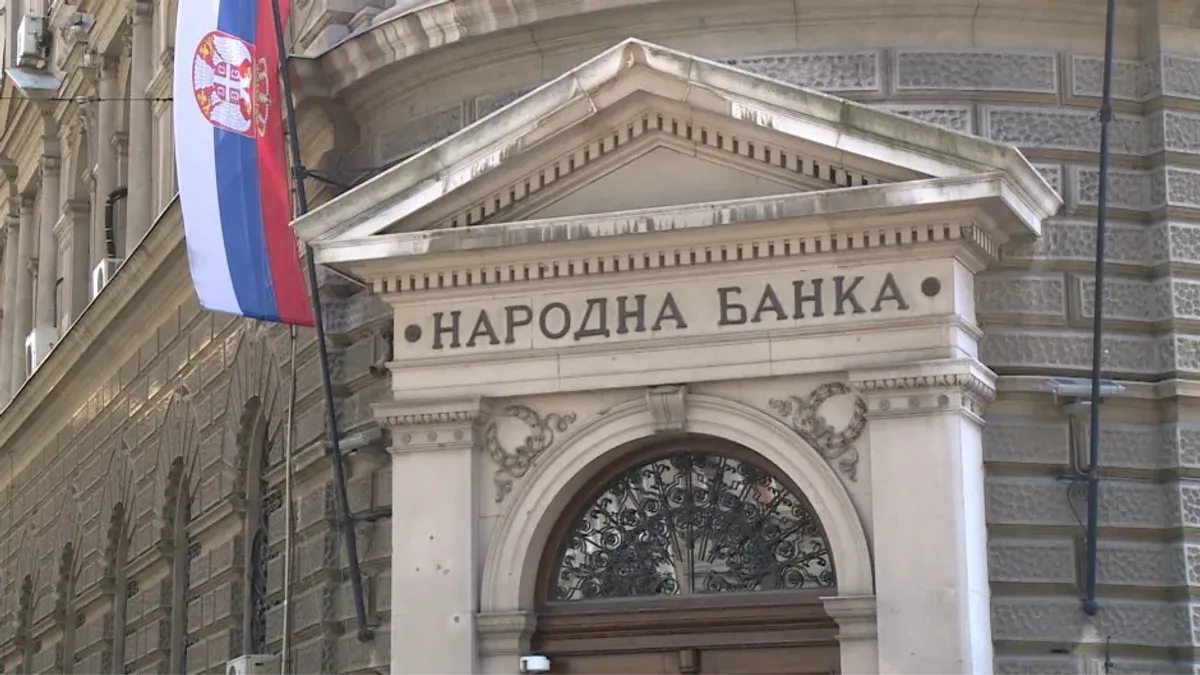
NBS Turns to AI for Prices as Daily Listings Start
Retailers in Serbia will publish daily price lists starting in September, while the National Bank of Serbia has announced an artificial intelligence model to track price movements.

Retailers in Serbia will have to publish daily price lists for their products starting in September, and the National Bank of Serbia (NBS) will track prices in parallel using a model built on artificial intelligence. Both announcements came on August 19 at the NBS presentation of its Inflation Report for August 2026.
Trade Minister Jagoda Lazarevic confirmed the daily price list obligation, ruling out any postponement on the same day. It stems from two pieces of legislation: the Law on Trade, in force since May 2026, and the Law on Consumer Protection, which has applied since August 2, 2026. Retailers were given four months to adjust.
“We have high expectations from the Law on Trading Practices, there was strong pressure, not to say lobbying, to postpone the start of the law’s implementation, and we were absolutely firm and stuck to the position that it had to start in September, and that is how it will be”
Lazarevic said, adding that the goal is to permanently ban a number of unfair trading practices, which she described as one of the major drivers of price growth in the recent period.
Full Effect Only in the Fall
The minister was clear that the current stability of food prices, recorded even after the regulation capping retail margins expired, is not yet the result of the new laws, since their most important provisions are only now being introduced.
“Only during the fall, once full implementation begins and once retailers start publishing price lists every day and once suppliers in the chain also change their contracts, will we see the real effect”
Lazarevic said. In other words, the real test of the legislation will only be visible once suppliers, not just retailers on the shelves, adjust their contracts to the new rules.
An AI Powered Model
NBS Governor Jorgovanka Tabakovic announced at the same presentation that the central bank will use a model built on artificial intelligence to track prices and produce short term estimates of their movement.
“For our new model, in which we use artificial intelligence and track all the prices that appear, it will be extremely important that we have reliable data from daily reports”
Tabakovic said. According to her, the daily price lists that retailers will be required to publish from September will become input data for that model, directly linking the minister’s announcement to the governor’s. The goal is for the NBS to get a read on the direction prices are heading before the Statistical Office of the Republic of Serbia (RZS) releases official inflation figures.
Tabakovic also said that after the retail margin cap was lifted, some central bank experts had expected prices to largely return to their earlier level, but that forecast did not hold. By her estimate, at most a third of products could have gone back to their older price.
“I was not right because I was looking into a crystal ball, but because you, and we on our part, showed authority”
the governor told the minister, adding that the Ministry of Trade and other institutions had shown a resolve that influenced how market participants behaved.
Inflation at 1.9 Percent, Exchange Rate Above 117 Dinars
As we reported when covering that same report, the NBS also announced at the presentation that inflation in July stood at 1.9 percent, while the 2026 GDP growth projection was raised to 3.2 percent. The NBS official middle exchange rate for August 20 is 117.3586 dinars per euro.
The four month window the government gave retailers to adjust runs out at the end of the year, which also gives the NBS a timeframe in which its new model will only just be starting to collect reliable daily price data, rather than relying solely on the RZS’s monthly reports as it has until now.