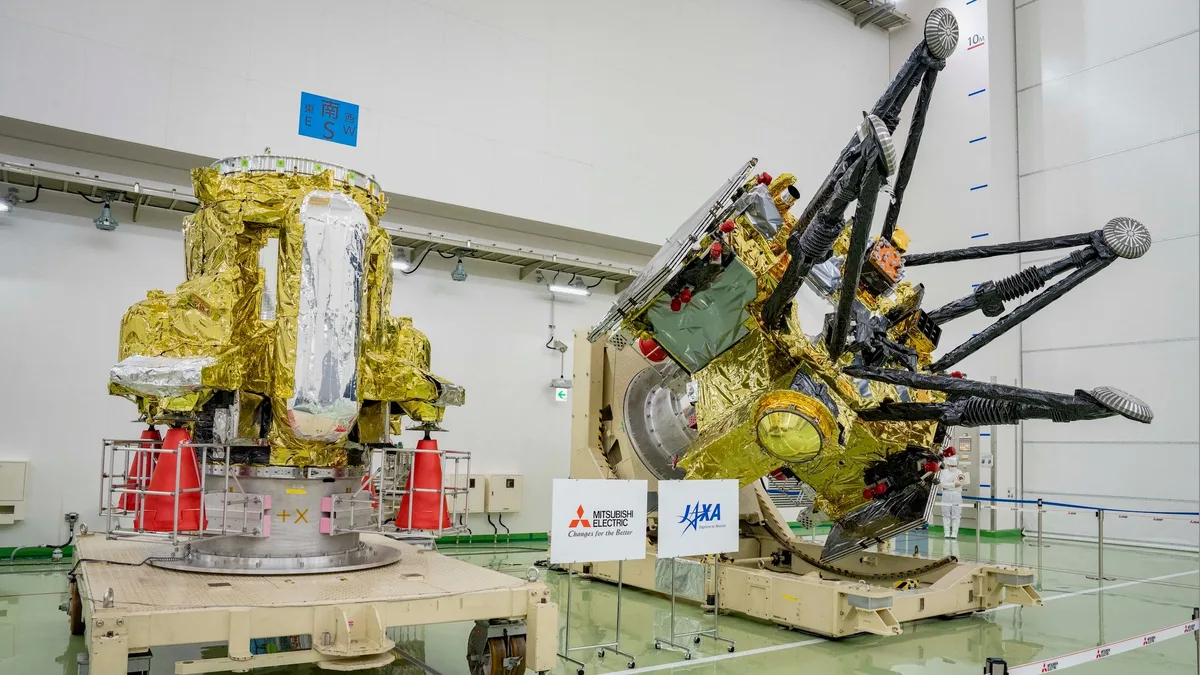
Japan: MMX Probe to Phobos Launches October 20
JAXA has announced the launch date for the MMX mission: the probe lifts off October 20 aboard an H3 rocket toward the Martian moon Phobos, with the sample due back on Earth in 2031.

Japan’s space agency (JAXA) announced the exact launch schedule for its Martian Moons eXploration probe, known as MMX, on August 20, 2026. Liftoff is set for October 20, 2026, at 4:41:03 a.m. Japan time, which is 7:41 p.m. on October 19 GMT. The probe will launch from the Yoshinobu complex at the Tanegashima Space Center aboard an H3 rocket, on that vehicle’s tenth flight, designated H3 F10. The mission’s target is Phobos, the larger of the two Martian moons, where MMX is meant to land and collect at least 10 grams of surface material. The smaller moon, Deimos, will only be observed from orbit, with no landing planned.
This is Japan’s first attempt to bring back a sample from the surface of either Martian moon. The project was originally planned for 2024, but the launch date has since slipped to 2026. JAXA’s statement also lists a backup window running from October 21 to November 7, 2026, in case the October 20 launch does not go ahead for any reason. The agency cautions that the exact launch time could shift within that window: “The launch time may change during the reserved launch period,” the statement reads.
At launch, the probe will weigh about 4,000 kilograms, roughly 1,900 kilograms of which is propellant. It carries seven scientific instruments, including the MEGANE gamma ray and neutron spectrometer supplied by the American space agency NASA, along with a 4K and 8K camera developed together with Japan’s NHK broadcaster, the first camera expected to capture footage of Mars in 8K resolution. Landing on Phobos alongside MMX will be a small rover called IDEFIX, weighing under 30 kilograms and built by the French space agency CNES together with Germany’s DLR. Its name comes from the dog in the Asterix comic books.
Are Phobos and Deimos Captured Asteroids?
The central scientific question MMX is meant to answer is the origin of Phobos and Deimos: whether they are asteroids that Mars’s gravity captured long ago, or the remnants of a larger body that once collided with the planet. According to JAXA, the answer could help explain how the Mars system itself formed, and by extension how the solar system took shape. The agency’s statement also raises the possibility that Phobos could one day serve as a kind of natural space station, as part of the technology development needed for future crewed missions to Mars.
After collecting its sample, MMX is set to leave Phobos and send a return capsule back to Earth. The capsule’s landing is planned for Australia in 2031. That date is where the available sources agree, while accounts differ on how long the mission will run overall. The website phys.org reports that the probe will remain in orbit around Mars for about three years, while Wikipedia lists the mission’s total duration, from launch to the sample’s return to Earth, as five years. JAXA’s own statements so far do not make clear which of the two figures more accurately describes the flight schedule.
Even the date announced on August 20 is not entirely final. JAXA is holding a backup window open through November 7 and explicitly notes that the launch time within that window could change, meaning October 20 remains the announced target rather than a guaranteed one. The mission’s central scientific question, the origin of the Martian moons, will stay open until 2031, when the Phobos sample is expected to reach laboratories on Earth for analysis by independent teams of scientists.