Japan's MMX probe launches Monday to fetch a Phobos sample
An H3 rocket from Tanegashima Space Center carries a spacecraft meant to bring back at least 10 grams of soil from Phobos, the first sample from any moon other than Earth's.
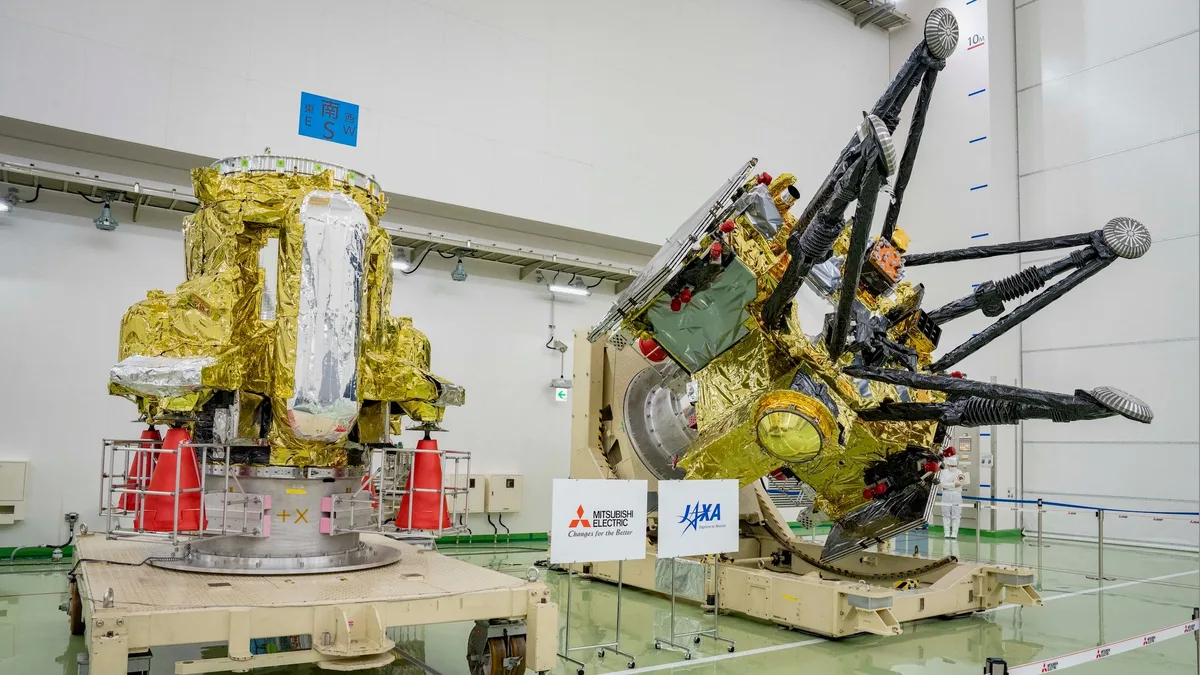
The MMX (Martian Moons eXploration) spacecraft launches on Monday, October 19, at 9:41 p.m. Serbian time, from the Yoshinobu launch complex at the Tanegashima Space Center in southern Japan. It rides on an H3 rocket, flight number 10 (H3 F10). In Japan that is Tuesday, October 20, at 4:41:03 a.m., and in UTC it is October 19 at 7:41 p.m.
The mission is led by the Japanese space agency JAXA, with NASA, France’s CNES, Germany’s DLR and the European Space Agency (ESA) as partners. JAXA announced the launch time on August 20 and set a backup window from October 21 to November 7, 2026. The same announcement says the departure time may shift.
The goal is to bring back at least 10 grams of material from Phobos, the larger of Mars’ two moons. If everything goes to plan, it will be the first sample from any moon other than Earth’s.
What does the spacecraft carry, and who supplied what?
The mission has 11 science instruments in total: seven on the main spacecraft and four on the rover. The main spacecraft also carries a radiation monitor, two high-resolution cameras and two sampling devices. The IDEFIX rover weighs 25 kilograms, but because of Phobos’ weak gravity it will weigh about as much as 15 grams do on Earth.
NASA contributed:
- the MEGANE spectrometer, which measures gamma rays and neutrons from the surface of Phobos to determine its chemical makeup; it was developed by the Johns Hopkins University Applied Physics Laboratory
- the P-Sampler pneumatic sampler, built by Honeybee Robotics, a Blue Origin company
- communications and navigation support through its Deep Space Network, plus funding for the American scientists on the mission team
P-Sampler is mounted on one of the spacecraft’s legs and collects soil with high-pressure jets of nitrogen. JAXA’s C-Sampler complements it by drilling cores a few centimeters deeper than the surface sample. NASA will keep about 15 percent of the returned material at the Astromaterials Laboratory at Johnson Space Center in Houston.
“Samples from MMX will deliver paradigm-shifting science about the Martian system for generations to come, especially now, as NASA prepares to send the first humans to Mars. The NASA-JAXA partnership on curating the samples is hugely valuable, and I am proud that NASA Science supports that part of the mission and will share portions of the samples for study, as we continue to expand our understanding of the universe for the benefit of all,” said Nikki Fox, associate administrator of NASA’s Science Mission Directorate, in an agency statement.
How long is the trip to the sample?
The spacecraft needs about a year to reach Mars. According to ESA, it enters orbit around the planet in August 2027 and circles Phobos from September 2027. After observing Phobos and Deimos from a distance, IDEFIX descends in early 2029.
The two agencies give different dates for the sampling. NASA says the sample will be collected in December 2028 at the earliest, while ESA says the spacecraft lands on Phobos and takes the sample in 2030. The capsule with the material returns to Earth in 2031 and lands in Australia, then travels to Japan, where the sample will be extracted, catalogued and shared with partners. On the way back, the spacecraft flies past Deimos and Mars and images them again.
Why is Phobos such a puzzle?
According to Phys.org, Phobos is the larger and closer of the two moons: its average diameter is 22.2 kilometers, against 12.5 kilometers for Deimos. American astronomer Asaph Hall discovered both in 1877 at the Naval Observatory in Washington. Their origin is unsettled, and two hypotheses dominate. One is a giant impact on Mars, after which Phobos and Deimos would be surviving remnants of material thrown into orbit (simulations by Pascal Rosenblatt of the Laboratory of Planetology and Geodynamics in Nantes show that these two moons are exactly what would remain). The other is captured asteroids.
The capture hypothesis has a difficulty: it requires an extremely dense Martian atmosphere in the past, and captured bodies usually end up on elongated orbits, while the orbits of Phobos and Deimos are almost circular. That is why a sample could settle the question. If it contains a lot of material from Mars itself, that favors an impact; if it resembles meteorites from known types of asteroids, it favors capture.
“Phobos and Deimos may be remnants of a huge impact on Mars that sent material into orbit around the planet, or ancient asteroids captured by Mars’ gravity billions of years ago. The answer will help illuminate that early epoch, when Earth and the other inner planets may have received much of their water and organic compounds,” said Tom Statler, MMX program executive and program scientist at NASA headquarters.
The project’s European scientist, Elliot Sefton-Nash, stresses that all the value lies in the laboratories on Earth:
“Bringing samples to our most sophisticated laboratories on Earth is a multiplier of discovery, because our most precise instruments are too large, too complex or too sensitive to send into space. And when the mission is over, future generations of scientists will study the Phobos samples with even more advanced instruments: samples brought to Earth are the gift that keeps on giving.”
His line about the mission as a whole reads: “The data and samples that MMX returns are a window for studying the evolution of Mars and the Solar System.”
Where to watch the launch, and what it does not guarantee
JAXA streams the launch live on its YouTube channel, in Japanese and English. ESA says it will publish an image on October 20 confirming that the launch succeeded.
Departure is only the first step: at least two more years remain before the sample is collected, and the backup window running to November 7 shows the date can slip. The question of where Phobos came from stays open until the material is analyzed, and even then the answer will depend on what the sample actually contains.