PSR J1856-0039: the Lightest Neutron Star Pair Found
A pulsar and its companion have a combined mass of 2.48841 solar masses and orbit each other in 2.36 hours. A Chinese team's measurements agree with Einstein's theory.
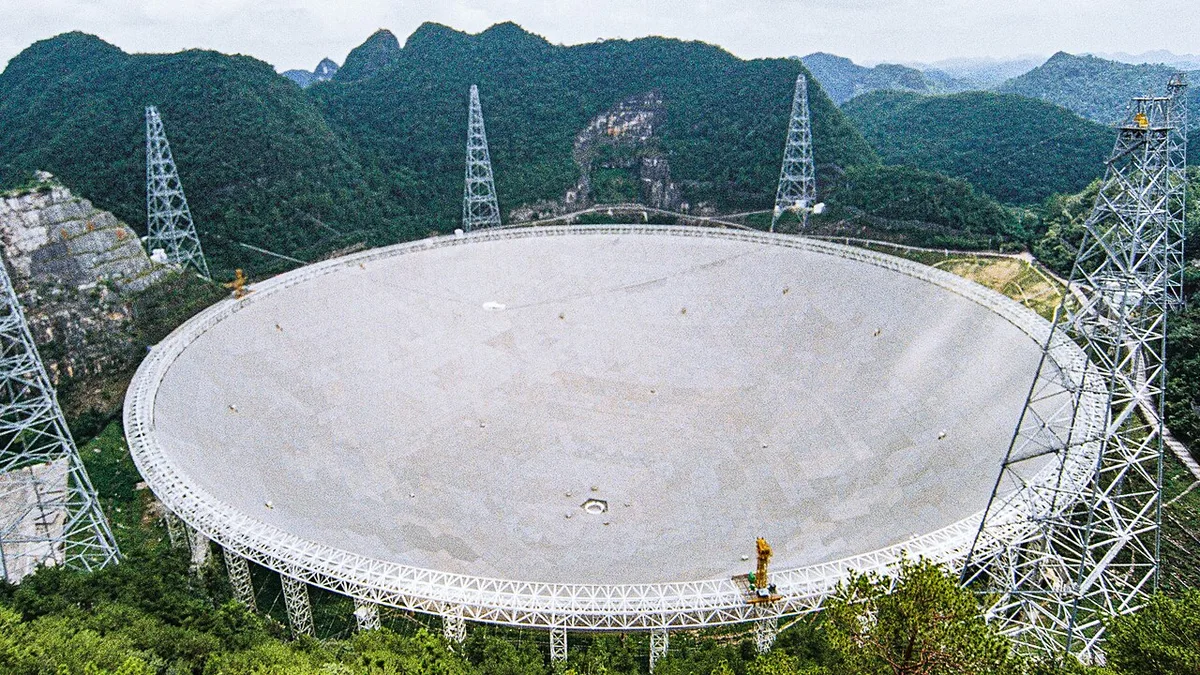
A team of astronomers from the Chinese Academy of Sciences and the State Key Laboratory of Radio Astronomy and Technology in Beijing has measured the masses of two neutron stars orbiting each other, and the total is the lowest of any known binary of this kind: 2.48841 ± 0.00015 solar masses. The system is called PSR J1856-0039, it was discovered with the FAST radio telescope, and the study appeared in Physical Review Letters. Phys.org reported on it on October 2.
We covered neutron stars recently, in a piece on an X-ray flash lasting almost ten minutes. This is a different kind of finding: a binary whose masses and orbit can be measured to four or five decimal places.
What exactly was measured?
A neutron star is the dense remnant of a massive star that exploded at the end of its life. A pulsar is a neutron star that spins and sends out beams of radio waves, so it appears to blink whenever the beam sweeps across Earth. In this system the pulsar turns on its axis once every 23.4 milliseconds, and its companion is another neutron star.
According to the study, which is also posted on arXiv as 2607.27333:
- the pulsar has a mass of 1.304 ± 0.022 solar masses and the companion 1.185 ± 0.022
- the stars orbit each other in 2.36 hours, the second shortest orbital period among confirmed double neutron stars
- the orbital eccentricity is 0.106, so the path is slightly elongated
- the closest point of the orbit, the periastron, shifts by 17.5859 ± 0.0007 degrees per year
- the orbital inclination is 133.2 ± 1.1 degrees
The data were gathered in 17 observing sessions between 2020 and 2025, with 253 pulse arrival time measurements. The source is faint, with a mean flux density of about 0.1 millijansky that varies from session to session. The 500-meter FAST dish sits in the Dawodang depression in southwestern China. The first author is Z. L. Yang, and among the 13 co-authors is JinLin Han, who explained to Phys.org how the system came to the team’s attention.
“We are conducting a pulsar search with FAST and have discovered about 900 pulsars so far,” Han told Phys.org. According to him, PSR J1856-0039 was first recorded on May 4, 2020.
Does the orbit agree with Einstein’s theory?
Under general relativity, two stars in orbit emit gravitational waves and lose energy, so they gradually move closer and their orbital period shortens. From the measurements the team isolated three relativistic effects: the shrinking of the orbital period, the shift of the periastron and the Einstein delay, a timing offset of 0.445 ± 0.011 milliseconds. From these, and within general relativity, the masses of both stars were calculated.
The ratio of the measured to the predicted orbital decay caused by gravitational waves is 1.009 ± 0.014 (68 percent confidence interval). In other words, measurement and theory differ by less than one percent, within the measurement error. According to the authors, the system ranks second among confirmed double neutron stars for the strength of its relativistic effects.
What lies ahead for this system?
By the team’s calculation, the two stars will merge in about 82 million years. Han described the outcome this way:
“This system has the lowest total mass measured to date among all double neutron stars, which means its merger will probably produce a massive neutron star rather than a black hole, giving a unique insight into the equation of state of ultra-dense matter.”
The authors phrased the same conclusion more cautiously: the merger may produce a stable neutron star, but the remnant could also collapse into a black hole once its rotation slows down.
The main goal of the long-term monitoring is the Lense-Thirring effect, the dragging of spacetime around a rotating star. Han told Phys.org:
“This system has the greatest potential for detecting the Lense-Thirring effect (frame dragging) thanks to its compact orbit, favorable inclination and exceptional timing precision.”
If the effect is measured, it could also yield the star’s moment of inertia, and with it the first determination of the state of matter in its interior. “It will be a difficult, long-term effort, probably ten years, and my postdoctoral researcher Dr. Zonglin Yang will carry it out,” Han added.
What does this study not prove?
The study describes a single system, not the whole population of neutron stars, so it cannot tell us how double neutron stars usually form. The agreement with general relativity was measured with an error of 1.4 percent, which is not the same as confirmation at every level of precision. The masses were calculated within the Damour-Deruelle model of general relativity in the Tempo2 software, so the result holds inside that framework.
The Lense-Thirring effect has not been measured yet, only estimated to be best observable in this system. The outcome of the merger, a stable star or a black hole, remains open and depends on how much the remnant’s rotation slows down.