

FRB 20240304B: Farthest Radio Burst Traced to Dwarf Galaxy
A fast radio burst caught by MeerKAT dates to three billion years after the Big Bang. James Webb found its source: a dwarf galaxy about 1,000 times less massive than expected.
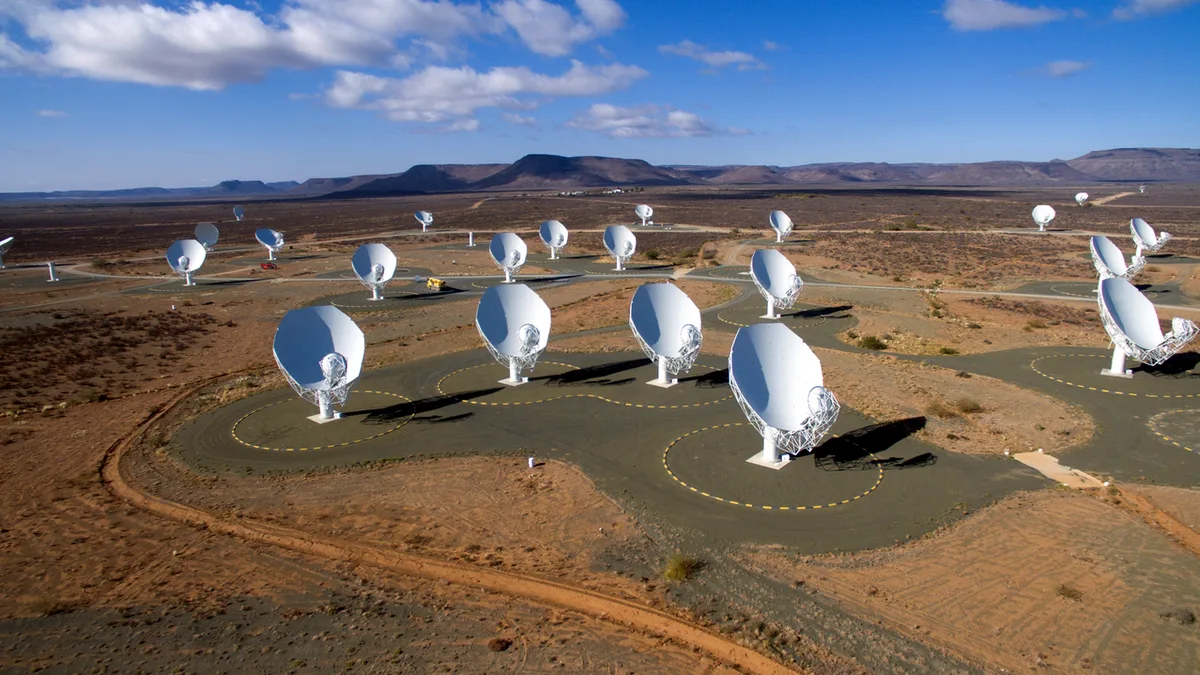
An international team of astronomers, including researchers from the universities of Manchester, Oxford and Sydney, has pinned down the origin of the most distant fast radio burst (FRB) recorded so far. The paper was published this week in Science. The MeerKAT radio telescope in South Africa picked up the signal, FRB 20240304B, on March 4, 2024, and the James Webb space telescope found its host galaxy.
Fast radio bursts last a few milliseconds. They were first discovered in 2007, and more than 10,000 have been recorded since. Some repeat, others flash only once. According to Mondo’s description, in those few milliseconds they release the energy the Sun produces over months, even years. Their origin is still unexplained.
How was the host galaxy found?
The burst was detected by the MeerTRAP team, which Ben Stappers of the University of Manchester leads at the Jodrell Bank centre. According to Universe Today, searches with ground-based observatories and through archival images turned up nothing. Only the NIRCam and NIRSpec instruments on James Webb found the galaxy, and they also gave a spectroscopic redshift of z = 2.148, with an uncertainty of 0.001. That corresponds to about three billion years after the Big Bang.
The signal’s dispersion measure, which describes how much free electrons in space stretched and slowed it, is about 2,330 pc cm⁻³. The paper is titled “A fast radio burst at redshift 2, three billion years after the Big Bang”. According to the University of Manchester, the lead author is Manisha Caleb of the University of Sydney. Mondo and Zvornik Danas name Dr. Temiya Nanayakkara of the same university as one of the lead researchers.
The sources also disagree on how long the signal traveled. Mondo and Zvornik Danas write that it took more than 10 billion years to reach Earth, Universe Today more than 11 billion. The Manchester release says only that the burst corresponds to a time three billion years after the Big Bang. According to Universe Today, the finding doubles the redshift range of localized fast radio bursts and spans about 80 percent of the history of the universe.
Why did the galaxy come as a surprise?
Most galaxies where FRBs have been found are massive and actively forming stars. This one was about 1,000 times less massive than expected. The team estimates that most of its stars may have formed within roughly 30 million years, during the peak of star formation in the universe, known as cosmic noon.
Caleb said in the University of Manchester release (translated from the original):
“We thought it would be a big, nicely shaped galaxy with lots of stars, and it turned out to be a small dwarf, although it was actively forming stars.”
Stappers said in the same release: “This galaxy stands out in the entire sample we have. And that was not what we expected” (translated from the original).
What does it mean for the origin of the bursts?
Two theories stand against each other: the merger of two neutron stars, or a single young neutron star with an extremely strong magnetic field, a magnetar. Caleb considers the first unlikely: “Our work indicates that it is very unlikely this FRB was produced by a merger” (translated from the original).
Nanayakkara told Zvornik Danas that any mechanism has to explain the fact that a burst can arise “in… very young galaxies with very little metal”. Mondo also quotes his line: “When that signal was created, there was no Earth, there was no Sun”.
Matthew Bailes of Swinburne University, one of the astronomers involved in the first discovery of fast radio bursts, described the new study as “confirmation of how powerful bursts are as a tool for exploring the universe”. Astrophysicist Sarah Webb, who was not part of the research, said the finding suggests such signals were “probably very common in the early universe”.
The localization software was developed by Dr. Kaustubh Rajwade of the Department of Physics at the University of Oxford. “MeerKAT is uniquely positioned to find FRBs at these distances,” he said (translated from the original). The team estimates that MeerKAT could detect and localize a few such bursts a year, out to more than halfway back to the beginning of the universe.
What this does not prove
This is one burst and one galaxy. A single example does not show how common such hosts are in the early universe. Mondo reports that it is not yet known whether FRB 20240304B will ever repeat its signal. The conclusion that a neutron star merger is unlikely remains the team’s estimate, not a ruled-out possibility, while magnetars remain one of the theories, without conclusive proof. Caleb herself says it is not known what produces them.


