FLIP Method Finds 51 Eridani b in Old Webb Telescope Data
Northwestern's FLIP method subtracts a calculated starlight glare from the image, pulling out a planet that earlier processing missed in two-year-old Webb data.
Astronomers at Northwestern University published an image-processing method in Nature on November 4, 2026, that found the giant planet 51 Eridani b in data from the James Webb Space Telescope that is two years old. The planet was discovered earlier by ground-based telescopes, but at a wavelength of 4.3 micrometers, where carbon dioxide strongly absorbs infrared light, earlier processing could not separate it from the glare of its host star.
The method is called FLIP, short for Physics-Based Learning for Imaging Planets. It was developed at Northwestern’s CIERA astrophysics center. The lead author is Rodrigo Ferrer Chavez, a doctoral student in astronomy, and the co-author is Jason Wang, an assistant professor of physics and astronomy at the same university.
Why is a planet next to a star so hard to image?
Sources differ on how faint a planet is. Scientific American reports that even the largest planets can be more than 10,000 times dimmer than the star they orbit. According to Bioengineer.org, Ferrer Chavez says planets are about a million times dimmer than their stars, and young giant planets about 100,000 times.
The James Webb telescope therefore carries a coronagraph, a mask inside the instrument that blocks most of the starlight. “It’s kind of like an artificial eclipse,” Ferrer Chavez said. Some glare still gets through, so astronomers image a similar reference star and subtract its glare from the image of the target.
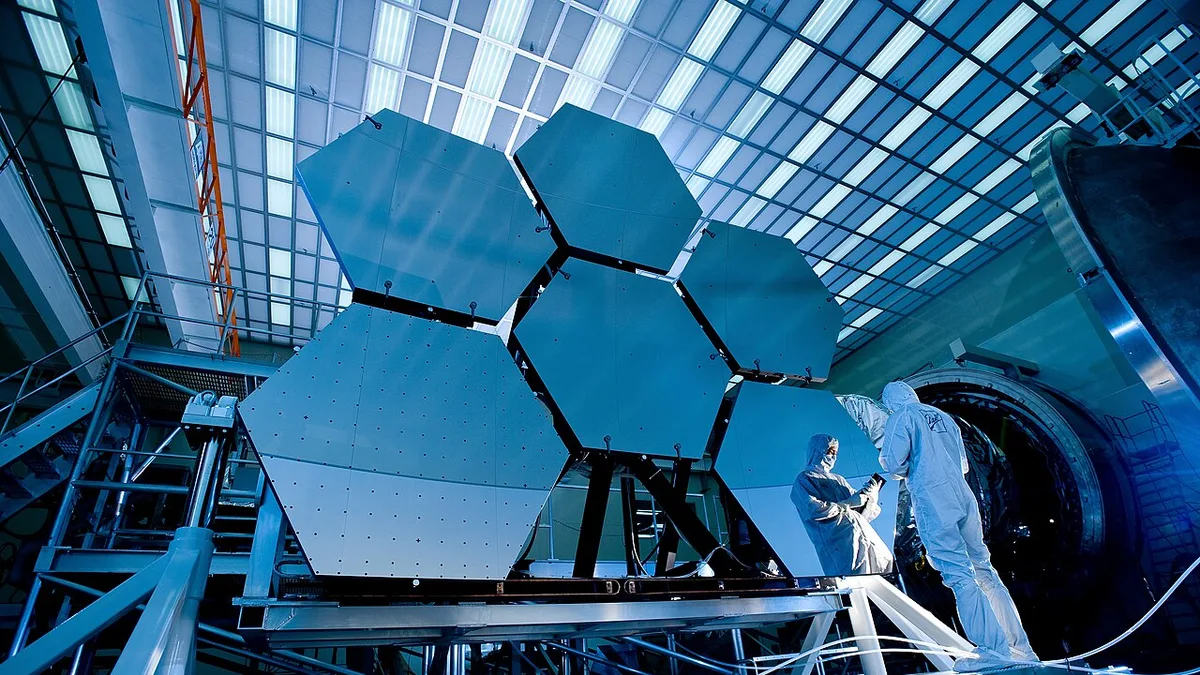
That template is captured at a different moment, and the telescope is never in exactly the same state twice. The star sits slightly off center, temperatures shift, and the 6.5-meter mirror flexes a little. Wang said thermal changes can expand or shrink the mirror by one picometer, and that the motors of the cooler that keeps the instruments cold cause vibrations. What remains is a trace of light that can hide a faint planet.
What does FLIP do differently?
Instead of using someone else’s glare, FLIP builds a physical model of the telescope’s optics, including tiny thermal shifts and vibrations, and calculates how the target star’s light passes through it. The team tuned millions of parameters of this “digital twin” until the simulated glare matched the real image, then subtracted the calculated glare. Ferrer Chavez explains that shifts and tilts of just a few nanometers change the pattern of light, and that the model tracks them more precisely than a reference image does.
The tools are similar to those used to train artificial intelligence models, but artificial intelligence does not recognize the planets. According to Wang, the physics of the telescope is known, so there is no need for that.
What did the test on three stars show?
FLIP was tested on observations of three systems: HIP 65426, 51 Eridani and TYC 5899. The first two are known to have planets, the third is not. Sensitivity to faint planets was 2 to 15 times higher than with standard techniques, and the gain is greatest close to the star, where planets like Earth orbit.
The most visible result is 51 Eridani b. In an image from the NIRCam instrument through the F430M filter, the standard KLIP method failed to pull out the planet, while FLIP produced a detection above five sigma, at the expected position and with the expected shape of the signal. Wang stresses that these are real data, science that went unused because there was no proper tool to process it.
Dimitri Mawet, a senior research scientist at NASA’s Jet Propulsion Laboratory who was not part of the study, assessed the work:
“This is a significant result.”
He added that a computational model of the glare has been considered for more than a decade but until now could not beat methods based on physically measured reference stars. “Ferrer Chavez and colleagues show that it can,” he said.
What does this mean for future observatories?
The goal is to make it easier to build Webb’s successor, NASA’s Habitable Worlds Observatory, planned for launch in the 2040s. Imaging an Earth-sized planet directly requires a telescope 100 to 1,000 times more stable than Webb, which has not been achieved even in a laboratory, Ferrer Chavez says. If software cleans up the glare better, the hardware can afford to shake a little more.
“Physics-based post-processing like this could likely relax some of the stability error budget for this observatory, and that alone would be important,” Mawet said.
The optics will still have to hold still to within a trillionth of a meter, because Earth-like planets are about 10 billion times dimmer than their stars. Ferrer Chavez sums it up: “If our approach works, building this new observatory could be very hard, but not really, really, really hard.”
What the result does not prove
The method was verified on three star systems, and the planet it recovered was already known, so this confirms the procedure on a known object rather than discovering a new planet. The 2 to 15 times gain in sensitivity was measured on those observations and says nothing about Earth-sized planets, for which telescope stability would remain the limit. According to Mawet, the requirements for the future observatory’s optics remain strict after this work.