

Hubble: Radiation Left Galaxies Before Supernova Winds
Hubble observations of nearby galaxies challenge the leading explanation of reionization, the phase when the young universe became transparent to ultraviolet light.
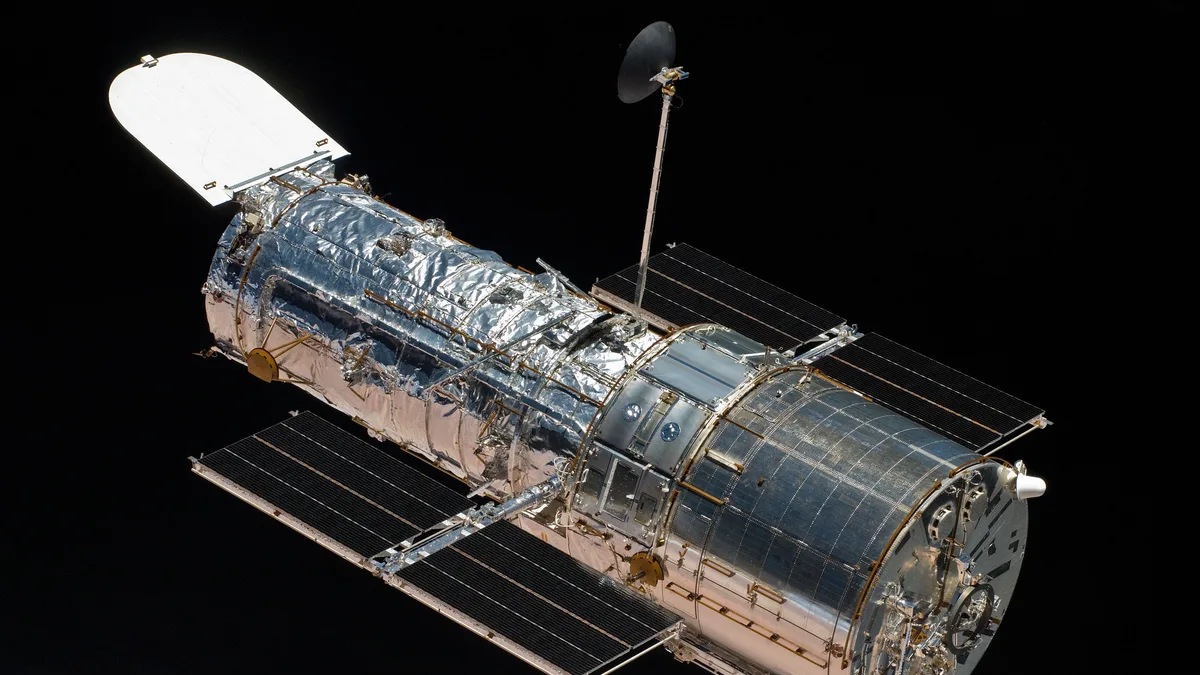
Ionizing radiation escapes from nearby galaxies with rapid star formation before galactic winds have formed in them, according to Hubble Space Telescope observations published in Nature Astronomy. The finding challenges one of the leading explanations of reionization, the period within the first billion years after the Big Bang when the universe became transparent to ultraviolet light.
The paper is titled “Lyman continuum escape during the onset of galactic winds in compact starbursts” (DOI 10.1038/s41550-026-02999-z). The first author is Cody Carr, a postdoctoral researcher in the University of Michigan’s Department of Astronomy, who led and carried out the research while a postdoctoral researcher at Zhejiang University in China. The senior authors are Renyue Cen, director of the Center for Cosmology and Computational Astrophysics at Zhejiang University, and Stephan McCandliss, director of the Center for Astrophysical Sciences at Johns Hopkins University. Sally Oey, a professor of astronomy at Michigan, also contributed. Nearly 30 collaborators from more than ten institutions worked on the study.
What is reionization, and what is still unknown?
In the first billion years after the Big Bang, the universe was filled with a fog of neutral hydrogen that ultraviolet light could not pass through. Reionization began about 13 billion years ago: energetic radiation from early galaxies collided with neutral hydrogen and broke it apart into charged protons and electrons. Carr described how it ended:
“Eventually, when it had ionized most of the hydrogen filling intergalactic space, that was the end of reionization and we see the universe as it is today. We call reionization the last major phase transition of the universe.”
The open questions are which objects were radiating and how the radiation got out of galaxies at all. “We don’t know exactly which objects caused reionization or how it unfolded. We know it happened, but we don’t have complete answers to those questions,” Carr said in a University of Michigan statement.
The leading theory held until now says that winds driven by supernovae, the explosions of massive stars, cleared a path in early galaxies through which radiation escaped into intergalactic space.
What do Hubble’s spectra show?
The team used Hubble to observe nearby galaxies forming stars at an enormous rate (so-called starburst galaxies), similar to those thought to have taken part in reionization. They analyzed the galaxies’ spectra: which wavelengths of light escape and how fast the galactic winds move. Gas in the winds absorbs light at particular wavelengths and leaves dips in the spectrum, and the position and width of those dips reveal how the gas is moving.
Galaxies with the fastest winds let through the smallest share of ionizing radiation. “Basically, the way these galaxies leak ionizing radiation is not what we thought,” Carr said, then added: “Our observations show that these photons escape before galactic winds form.”
The result strengthens an alternative theory, in which young stars allowed radiation to escape before supernova explosions created winds strong enough to reshape the galaxies. McCandliss explains the mechanism this way:
“It appears that the energy the supernovae injected stirred up the surroundings and increased, rather than decreased, the coverage of neutral gas and dust that suppresses the escape of ionizing radiation.”
Cen, a senior author from Zhejiang University, warns of the consequence for models. In his words:
“Supernovae play a central role in cosmological hydrodynamic simulations that explain how ionizing radiation escapes from galaxies. Our findings point to the need to examine how the radiation and winds of young stars shape the surrounding gas before the first supernovae explode.”
Limits of the finding
The observed galaxies are nearby, not from the epoch of reionization; the authors use them as analogs of galaxies assumed to have helped drive reionization. The relationship they measured is between wind speed and the fraction of radiation that escapes, and the mechanism, as McCandliss and Cen describe it, follows from interpreting those observations.
The study does not rule out every role for winds. Smaller-scale winds around young stars may still play an important part, according to the source. Carr and colleagues are seeking more Hubble time to observe additional galaxies and test the idea further, and the result can already help the simulations astronomers use to better understand reionization. The work was also supported by a Hubble grant administered by the Space Telescope Science Institute.


