Comets and origin of life: Cambridge study casts doubt
Simulations show comets were very unlikely to have delivered hydrogen cyanide to the early Earth, while Mars was a more favorable target for such a delivery.
A team at the University of Cambridge published a study in late October 2026 in Scientific Reports whose results challenge the old idea that comets brought the building blocks of life to the early Earth. Computer modeling shows that comets could hardly have delivered hydrogen cyanide in amounts large enough for prebiotic chemistry. The hypothesis of comets as a source of these molecules is about a century old.
What exactly did the researchers study?
The paper is titled “Cometary impacts an unlikely pathway towards the origins of life on Earth” (Scientific Reports, volume 16, article 31688, DOI 10.1038/s41598-026-74214-y). The study is led by Dr. Richard Anslow of the Institute of Astronomy at the University of Cambridge. The available sources do not name the co-authors.
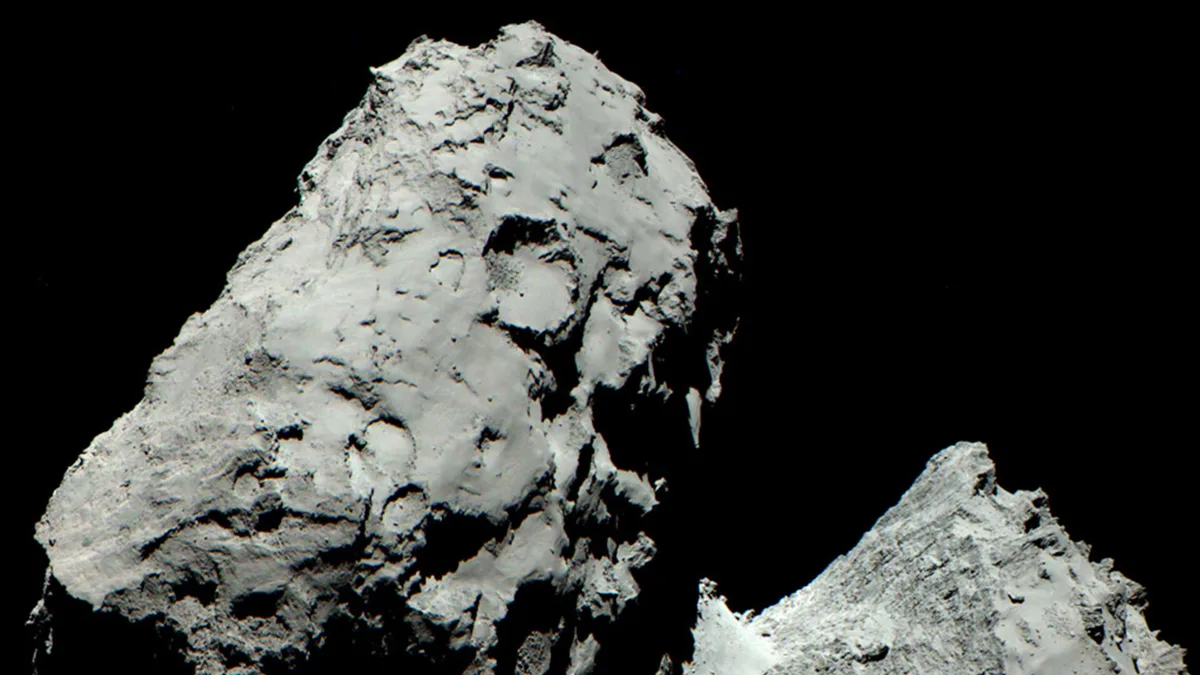
Comets in the Solar System do carry organic compounds. The Rosetta probe reached comet 67P/Churyumov-Gerasimenko in 2014. The COSAC and Ptolemy instruments on the Philae lander reported 16 organic compounds on its surface, and the ROSINA instrument on Rosetta itself later detected the amino acid glycine in the comet’s coma. Still, it is a long way from finding a molecule on a comet to proving that it reached Earth in a usable quantity.
The researchers therefore focused on hydrogen cyanide (HCN), a molecule that is common in comets and appears in proposed pathways to the origin of life. Laboratory experiments have shown that sufficiently concentrated hydrogen cyanide can help synthesize sugars, lipids and components of genetic material. The team modeled short-period comets, because their lower speed gives their molecules a better chance of surviving an impact.
Why did the molecules fail to survive?
According to the models, comets strike too fast and at too steep an angle, so fragile molecules would almost certainly have evaporated on impact. Earth’s atmosphere also acts as a filter: it destroys small comets and those arriving at oblique angles most readily. The authors write in the paper that comets, with their low density and weak mechanical strength, are prone to break up as they pass through the atmosphere.
The number of impacts was also dropping fast. The first 500 million years or so of Earth’s history was the period when comets fell most often, and after that the bombardment subsided. By the team’s estimate, there were at most a few opportunities for a comet to deliver hydrogen cyanide.
Even if a molecule survived, it would not have stayed concentrated for long. A rapid inflow of groundwater into a crater lake would have diluted it below the concentration useful for prebiotic chemistry, so the chemistry would have had to start immediately after the impact.
The result agrees with earlier work by Todd and Oberg, and Universe Today also cites a 2020 study according to which only the most favorable impacts (low angle, low speed, small radius) stay below the temperature at which hydrogen cyanide is destroyed.
Sci.News adds a figure: in 100,000 simulated bombardment histories of Earth, 54 percent contained no impact that would deliver hydrogen cyanide in a concentration sufficient for such chemistry. It follows that in the remaining 46 percent of simulations at least one impact crossed that threshold, though the available sources do not say how that outcome was distributed in more detail. Anslow rates the overall outcome, which includes the speed and angle of impact and everything that would follow, more strictly:
“It would really have to be one in a million, because it would not only require an impact at exactly the right speed and at exactly the right angle, but everything else would also have to line up afterwards, in terms of concentration and the speed at which the chemical beginnings of life got going. We cannot say with certainty that it did not happen that way. But it really looks like a rare event, at best a one-off.”
The quote is a free translation of the University of Cambridge press release, as carried by Phys.org and Sci.News. Anslow also described the broader impression this way: “It is a somewhat romantic idea, but our results suggest it is highly unlikely.”
Why did Mars turn out to be a better target?
The team also simulated impacts on Venus and Mars. Mars had considerably more successful deliveries, thanks to its weaker gravity and thinner atmosphere. Universe Today reports that comets survive on Mars five times more often than on Earth, but the authors themselves regard this as the most favorable possible case, with a number of other circumstances that weaken the idea.
Anslow phrased the conclusion cautiously:
“I am not saying it certainly happened on Mars, of course, but that it would be unlikely for it to have happened on Earth and not on Mars. Or the other, perhaps more probable possibility, that it did not happen on either of those two planets.”
Where did the chemistry of life come from, then?
As more likely sources, the authors name asteroid impacts, which were far more numerous than comet impacts, and chemical precursors that formed on Earth itself, with no outside input. The study builds on a 2023 paper by Anslow and colleagues, according to which comets in systems with nearby planets can “bounce” from planet to planet and leave organic molecules along the way. The researchers say the result could help in the search for life around other stars once successors to the James Webb Space Telescope, such as the proposed Habitable Worlds Observatory, come into operation: systems where such comets could exist would stand out among the candidates.
What the study does not prove
The paper is a modeling estimate, not an observation. The result depends on the assumptions built into the simulations, and the authors themselves say that delivery cannot be ruled out entirely, only that it is highly unlikely. The study deals with one molecule, hydrogen cyanide, and with short-period comets, so it says nothing about other compounds that comets carry. Nor does it prove that life arose from asteroid or Earth-based ingredients: the paper presents that as a more likely possibility, not as a result. Finally, the conclusion rests on a single set of models, and replication by other teams using their own assumptions would show how stable it is.