

Kosovo Assembly Narrows Specialist Chambers Jurisdiction
MPs backed a Democratic Party of Kosovo proposal in first reading with 91 votes, as KLA veterans blocked the entrance outside and the Srpska Lista MPs stayed away.
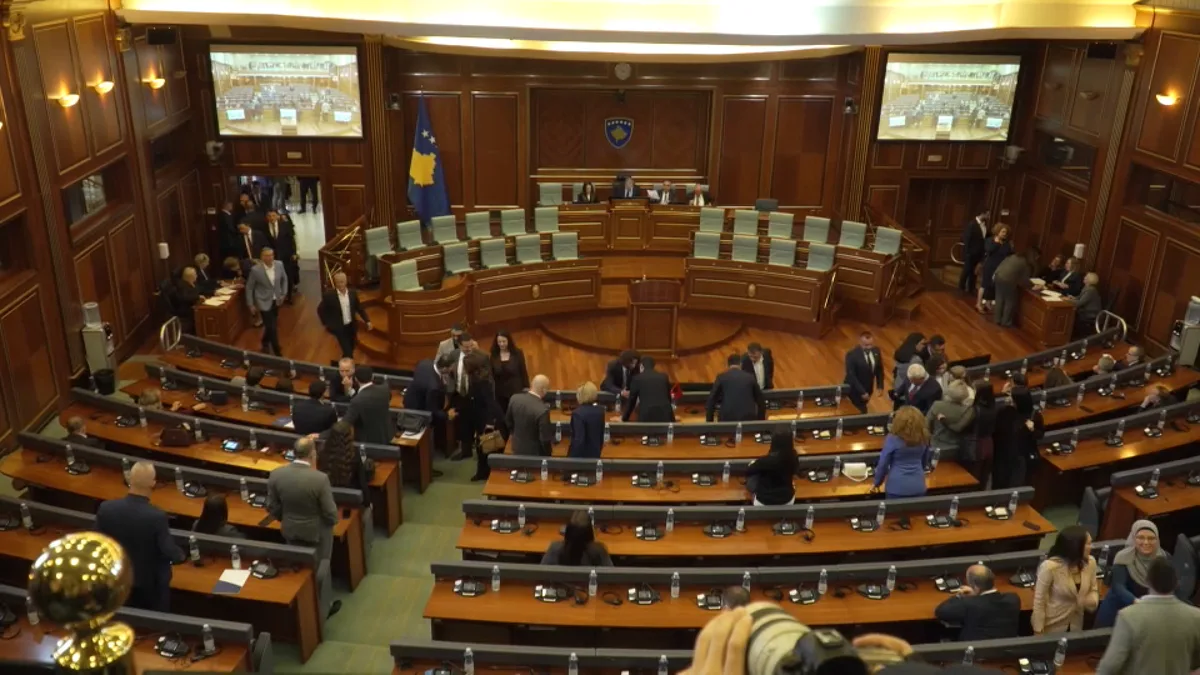
The Kosovo Assembly passed amendments to the Law on the Specialist Chambers and Specialist Prosecutor’s Office in first reading on Monday, October 5. According to N1, Danas, B92 and Kosovo Online, 91 MPs voted for the proposal of the Democratic Party of Kosovo (PDK), with no votes against and no abstentions. MPs of the Democratic League of Kosovo (LDK) did not take part in the vote, and Srpska Lista MPs did not come to the session. Assembly Speaker Albulena Haxhiu noted at the start that 101 MPs were in the chamber.
This is the first time the amendments have been put to a vote. We have previously reported on the negotiations between Bedri Hamza and Albin Kurti and on the pressure from KLA veterans, and now the exact content of the text is known.
What does the draft change in the Specialist Chambers’ jurisdiction?
The proposal is extensive, with 40 pages according to KoSSev. Its aim is to limit the work of the court in The Hague to the specific allegations in the 2011 report by Dick Marty. Under the draft, these are:
- unlawful removal of and trade in human organs, tissues and cells
- murders, torture and inhuman treatment in detention, but only if directly tied to organ harvesting
- acts committed from July 1, 1999 to December 31, 2000
General war crimes and crimes against humanity would move to the Special Department of the Basic Court in Pristina, and to Kosovo’s Court of Appeals and Supreme Court. The transfer of evidence is envisaged within 30 days.
The maximum sentence the court could impose would be 15 years in prison. Sentences would be served in prisons in Kosovo, and the President of Kosovo could pardon convicted persons individually.
The draft does not apply only to future cases. Within 30 days of the law entering into force, jurisdiction would be reviewed in all pending proceedings. If a verdict is not final, it would be annulled in the part that is no longer within the court’s jurisdiction.
That matters because of the September 16 verdict. The Specialist Chambers then convicted Hashim Thaci, Rexhep Selimi, Kadri Veseli and Jakup Krasniqi at first instance to a combined 81 years in prison. Thaci received 25 years and Selimi 13. For the other two, sources differ: Telegraf and B92 report that Veseli got 25 and Krasniqi 18 years, while KoSSev reports 18 for Veseli and 25 for Krasniqi. The verdict is under appeal. KoSSev adds that the text of the draft does not mean the sentences handed down are automatically reduced to 15 years, because the proposal still has to pass a second reading.
What did speakers say at the session?
Sponsor Perparim Gruda of the PDK said the law does not take away the Specialist Chambers’ right to deal with organ trafficking, but does take away part of their jurisdiction over war crimes. He also said:
“Kosovo will not change its Constitution and will not violate the international agreements we have with the Netherlands. What we are doing is moving war crimes to be tried in Kosovo. The law carries these powers for all future cases. For former leaders, if there is a case in the Supreme Court, it will be conducted in Kosovo.”
PDK leader Bedri Hamza spoke about responsibility and oversight:
“Every crime must be condemned, every victim has the right to seek justice. We are not closing the court for what we voted for, but we demand accountability and oversight.”
Prime Minister and Self-Determination leader Albin Kurti backed the proposal but voiced a reservation about the speed of the procedure. “We consider that the procedures were carried out hastily and that there was not enough analysis,” Kurti said. He added: “I would carry out a full analysis of the law and wait for the final verdict.”
The head of the Self-Determination parliamentary group, Arberie Nagavci, recalled 2015, when the law on the Specialist Chambers was adopted. “In 2015 the majority of MPs chose something different. The Constitution was amended and the law adopted,” Nagavci said, and added: “The amendment to the law that we will vote on today does not free the convicted persons and does not return KLA leaders to Kosovo.” According to N1, she also said that “the KLA cannot be equated with this kind of verdict.”
MP Jehona Lushaku Sadriu explained why the LDK did not vote. “Unilateral actions without coordination and an assessment of the consequences risk weakening the international support that Kosovo has,” she said, and according to Danas she stated that “the KLA war is sacred,” but that “no individual responsibility can be turned into collective guilt.” Ramush Haradinaj of the Alliance announced he would vote for the amendments and asked that both readings be completed on the same day.
What happened outside the Assembly building?
The session was scheduled for 9 a.m., and the legislation committee was due to meet at eight. It started late. The committee backed the proposal with nine votes in favor, and Kosovo Online reports that the Assembly approved, with 97 votes, a waiver of the 72-hour interval between the two readings. The other sources we reviewed do not mention that vote.
KLA veterans and participants in the “Not in My Name” protest gathered outside the building. According to B92, windows on the building were broken, pyrotechnics were thrown, and demonstrators blocked the entrance with a van. The organizers said no MP would be able to leave the building until the amendments were adopted in second reading as well. Kosovo police in riot gear were deployed around the Assembly.
What comes after the first reading?
The deadline for electing the President of Kosovo expires on October 6. The Constitutional Court determined that the 60-day period began on August 8, when the new Assembly was constituted, and if a president is not elected, the Assembly is dissolved and elections are called. The PDK has made adoption of the amendments a condition for talks on the president and wants both readings finished before the head of state is elected. According to Radio Gorazdevac, the session’s agenda covered only the first reading.
Gazeta Express, citing sources, reported that Kurti proposed a different order: first reading, then the election of the president, then the second reading. There was no confirmation from Self-Determination or the PDK. Hamza called on MPs to submit proposals for additions to the text between the two readings.
For now, the amendments are not law. The Specialist Chambers remain competent under the current text until the second reading is held and the law enters into force.


