CRTA: ballot photography rises from 40 to 48 percent
CRTA's evening update: ballot photography at 48 percent of sampled polling stations, UV lamp lapses at 30 percent, voting without documents at 8 percent.
The CRTA observer mission said tonight that in its sample of 500 polling stations, photographing of ballots was recorded at 48 percent of stations, and lapses in the use of the UV lamp at 30 percent. These are observers’ findings about how voting went in the snap parliamentary elections, not election results.
In its evening statement, CRTA says: “Photographing of ballots was recorded at 48 percent of polling stations in Serbia.” According to the mission’s data, voting without valid documents was observed at 8 percent of stations. Ballot photography was most often recorded in Belgrade, at 79 percent of stations, and in Vojvodina at 58 percent.
How did the numbers change during the day?
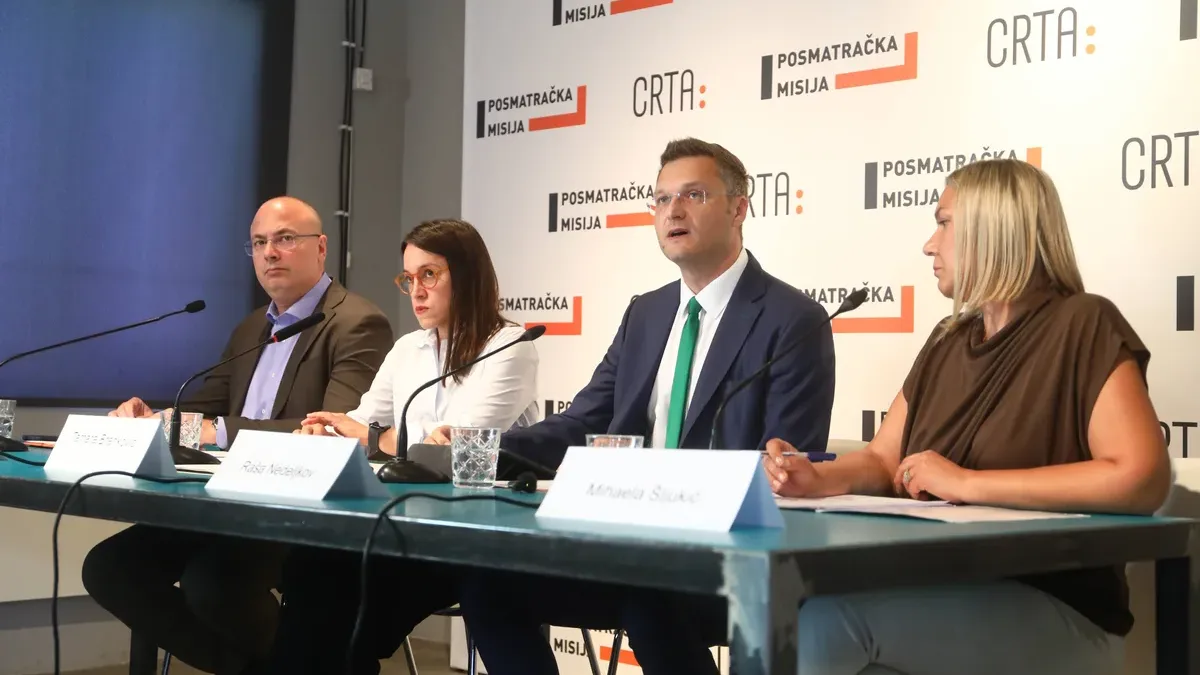
The mission’s program director, Rasa Nedeljkov, has presented the figures several times. By noon, CRTA had recorded ballot photography at one in four stations, and at the press conference after 4 p.m. the figure was 40 percent. The evening update puts it at 48. Other indicators moved over the same stretch:
- inconsistent use of spray and the UV lamp: 12 percent of stations in the noon update, 21 percent at 4 p.m., 30 percent tonight
- voting without valid documents: 6 percent at 4 p.m., 8 percent tonight
- pressure on voters, polling board members and observers: 29 percent of stations at 4 p.m.
- procedural lapses at 18 percent, and voting integrity endangered at 17 percent, also in the 4 p.m. update
In the noon update, which we covered at midday today, CRTA also said that polling stations opened late at 16 percent of those observed. Nedeljkov singled out two stations from the sample, in Zablje and Sjenica, where multiple ballots were recorded being dropped into the box.
Turnout is counted separately. According to Nedeljkov, by 7 p.m. 67.8 percent of registered voters had cast ballots, which is 12.3 percentage points more than at the same hour in the 2023 elections, and he expects a rise of three to four points in the last hour. CeSID reported 67.6 percent for the same hour, against 55.9 percent three years ago.
What does CRTA say about incidents?
The mission says that after a calm morning, election day was marked by growing pressure and isolated violent incidents outside polling stations, recorded in Belgrade, Pancevo, Vranje and Novi Sad. According to Danas, CRTA concludes: “Election day passed under the sign of pressure and obstruction of the work of polling boards.”
One of the cases the mission reported in particular is in Zemun. By its account, five or six men and a woman surrounded an observer outside a polling station, insulted her, pushed voting invitations into her hands and photographed her. In Kragujevac, as Nedeljkov put it, an unknown person falsely introduced himself to an observer as a member of CRTA’s legal team. The legal team called the police in Novi Sad over suspected vote buying and carousel voting.
CRTA warns that in a tight race any irregularity can matter greatly for the outcome, and urges polling boards, the election administration and political actors to ensure a peaceful vote count.
What does the RIK say, and what comes next?
The president of the Republic Electoral Commission (RIK), Vladimir Dimitrijevic, said before noon that voting at a large number of polling stations was passing without incidents or irregularities. “The only small challenges occurred at 8 a.m. because of great interest. All polling stations are now open,” Dimitrijevic said. We could not find a response from the commission to CRTA’s evening figures at the time of writing.
CRTA will hold its next press conference once it has processed data from 95 percent of stations in both samples. The ODIHR mission, led by Eoghan Murphy, will also present preliminary findings on the elections on October 26 at 3 p.m. Belgrade time. The mission has a core team of 14 members, 30 long-term observers and 300 requested short-term observers, and delegations from the OSCE Parliamentary Assembly, the Parliamentary Assembly of the Council of Europe and the European Parliament are joining it.