Plavsic buried in Banja Luka, Dodik and Cavic speak
After a funeral service at the Church of the Holy Trinity and a memorial at Banski Dvor, Dodik and Cavic spoke, and Radio Free Europe notes no Serbian officials attended.
Biljana Plavsic, the former president of Republika Srpska, was buried in Banja Luka on October 7, six days after she died in Belgrade. The farewell included a funeral service at the Church of the Holy Trinity and a memorial at Banski Dvor, and Radio Free Europe notes that no Serbian official attended the memorial, even though Plavsic died in Belgrade and a first farewell was held there the day before.
Plavsic died on October 1, in her 96th year. After the Belgrade farewell on October 6, her coffin was taken to Banja Luka. The Republika Srpska government formed a Funeral Committee to organize the memorial and the burial, a decision taken at a telephone session.
What happened in Banja Luka on October 7?
Metropolitan Jefrem of Banja Luka led the funeral service at the Church of the Holy Trinity. An honor guard of the Republika Srpska Interior Ministry stood by the coffin, and wreaths from Milorad Dodik, National Assembly Speaker Nenad Stevandic and Serb member of the Bosnia and Herzegovina Presidency Zeljka Cvijanovic were laid beside it.
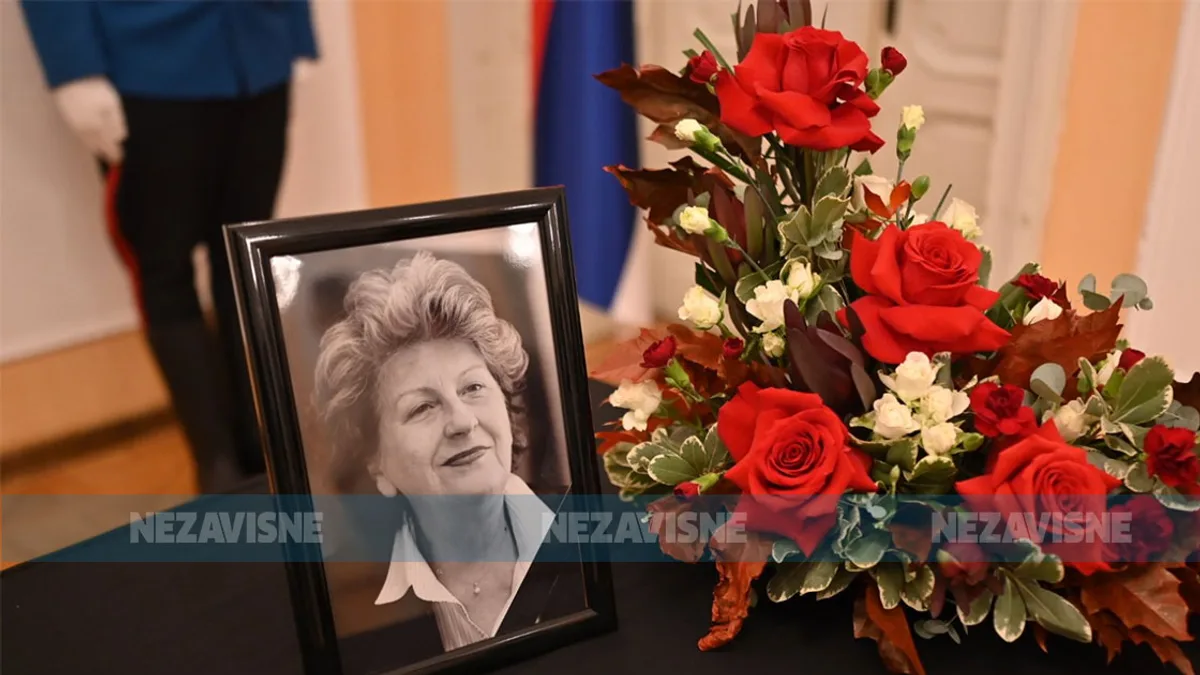
At Banski Dvor, an Interior Ministry honor guard stood beside Plavsic’s photograph, in front of which her decorations were displayed. A book of condolences was opened, and the highest officials of Republika Srpska were the first to sign it.
Sources differ on details of the burial. N1 announced that it would begin at 1:00 p.m. at the Sveti Pantelija cemetery, while Radio Free Europe names the city cemetery in Banja Luka. RTRS published the news that Plavsic had been buried at 1:10 p.m.
Who spoke at the memorial, and who came?
The speakers were SNSD leader Milorad Dodik, former Republika Srpska president Dragan Cavic and journalist Mira Lolic Mocevic. The message of the gathering, as relayed by RTRS, was that Plavsic would be written into Serb history in capital letters as the first woman president and a fighter for the Serb people and Republika Srpska.
Dodik said:
Plavsic gave others a chance and sacrificed her comfort as an outstanding intellectual for the political struggle for Republika Srpska.
And added:
Plavsic fought for the Serb people, and her only criterion in politics was whether you fight enough or not for the Serb people.
Cavic spoke about the end of her life, which, as he put it, was tied to the hardest years of the Serb people in Bosnia and Herzegovina at the end of the 20th century. He closed with this:
Plavsic is part of this history, and that is why today, as a Serb, I cannot accept the exclusivity and blindness of all those who reduce her entire life to a single unfortunate verdict.
Journalist Mira Lolic Mocevic said: “For me, Biljana Plavsic will always be President Biljana Plavsic,” and added: “She is written into Serb history in capital letters as the first woman president. She deserves that.”
Those present included:
- Republika Srpska government ministers Goran Selak and Zeljko Budimir
- President of the Academy of Sciences and Arts of Republika Srpska Dragoljub Mirjanic
- President of the Constitutional Court of Republika Srpska Dzerard Selman
- Acting director of the Office for International Cooperation Ana Trisic Babic
- former National Assembly Speaker Dragan Kalinic and former police director Dragomir Andan
- former Chairman of the Council of Ministers Svetozar Mihajlovic, former prime minister Radovan Viskovic and former DNS president Marko Pavic
- Professor Radomir Lukic
What does the Hague verdict say about Plavsic?
The speeches at Banski Dvor and the Hague verdict are read side by side today. The International Criminal Tribunal for the former Yugoslavia sentenced Plavsic on February 27, 2003, to 11 years in prison for persecuting Bosniaks, Croats and other non-Serb civilians in 37 municipalities in Bosnia and Herzegovina in 1992. According to Radio Free Europe, she pleaded guilty, and under the agreement the remaining charges, including genocide, were dropped. She was released on October 27, 2009, and, Radio Free Europe reports, was flown from Sweden to Belgrade on a Republika Srpska government plane, where then prime minister Milorad Dodik met her on the runway.
Before the memorial, Dodik said that Plavsic “deserves all honors.” Before politics, she was a university professor and dean of the Faculty of Natural Sciences and Mathematics in Sarajevo.
The sources do not explain why no Serbian official came to Banski Dvor. Radio Free Europe only notes that none were present.