Brussels Draft: Montenegro Nears Finish, Serbia Stalls
A draft of the European Commission's annual enlargement communication says Montenegro has met its closing benchmarks, while Serbia, Bosnia and Kosovo made no progress on the fundamentals.
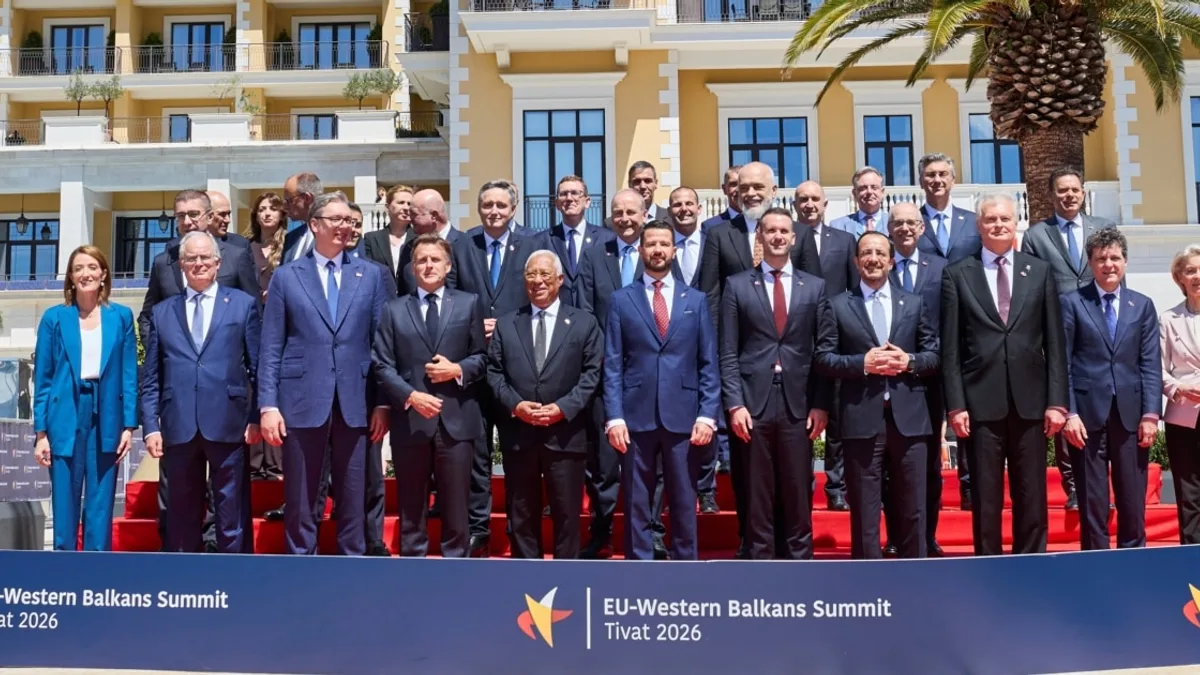
Serbia is among the countries that made no progress on the fundamentals in the European Commission’s draft enlargement package this year, in the same document that points to an end of accession talks for Montenegro in December. The draft annual communication on enlargement policy, which Radio Free Europe has seen, has not yet been adopted, and the Commission is due to publish the final package next week.
The fundamentals cover the rule of law, democratic institutions, public administration reform and economic criteria, and they set the overall pace of the negotiations. For Belgrade, the verdict on this part of the document matters more than any single step forward.
“Serbia, Bosnia and Herzegovina and Kosovo have not made progress in the fundamentals,” the draft communication of the European Commission states.
What does the draft say about Serbia?
The assessments are mostly critical. The draft records no progress on the rule of law or freedom of expression, and it still describes Serbia’s alignment with EU foreign policy as low. The topic predates this document: we previously reported on Marta Kos’s message that Serbia will struggle without aligning with the EU.
On the judiciary, the Commission notes that the initial backsliding caused by the so-called Mrdic laws has since been corrected. Those amendments had removed part of the safeguards for the independence of prosecutors and judges. The draft also finds that in Serbia “inappropriate pressure has increased significantly”.
Serbia is also listed, together with Bosnia and Herzegovina, Georgia and Turkey, among the countries where the risk of “state capture” remains high. The term describes a situation in which narrow interest groups take institutions under their control.
There are two positive developments:
- Serbia’s entry into the geographic scope of the Single Euro Payments Area (SEPA)
- the start of preparatory work on an agreement on conformity assessment of industrial products
Kosovo and normalization: what is asked of Belgrade?
The Commission again ties progress for Serbia and Kosovo on the road to the EU to real progress in normalizing relations. The draft is direct on this point.
“Implementation of the Agreement on the Path to Normalization and its Implementation Annex remains insufficient,” the draft says. The same section adds: “Normalization is not only a condition on the European path. It is key to the security, stability and economic development of both societies and the wider region.”
For Kosovo, the draft records no progress on forming the Association of Serb-majority Municipalities, which the dialogue agreement envisages. Pristina is expected to launch that process in line with its commitments, including the 2023 Ohrid Agreement. The status of the structures and services supported by Serbia should be settled under the dialogue agreements and Kosovo law, “and not through uncoordinated measures”, with structured consultations with representatives of Kosovo Serbs.
Why is Montenegro in a different position?
According to the draft, Podgorica has met the closing benchmarks in all negotiating chapters and could finish accession talks by the end of 2026, in December according to Montenegrin public broadcaster RTCG.
“Montenegro’s outstanding progress in the EU accession negotiations is proof that enlargement remains an achievable reality,” the draft states.
Among Montenegro’s reforms, the Commission highlights constitutional amendments that strengthened the independence of the Judicial and Prosecutorial Councils, a zero-tolerance policy on attacks against journalists, and alignment of its visa policy with the EU, which takes effect on October 31, 2026. Montenegro’s accession treaty would be the first to apply a “reinforced approach” to safeguard clauses, and it would serve as a model for future treaties.
This year’s report on Montenegro could be the last regular one. From next year it would be replaced by monitoring reports, and after the final intergovernmental conference Montenegro would become an active observer in most Council of the EU working groups. Montenegro, Albania, Moldova and Ukraine are the only countries for which the Commission presents “roadmaps” with deadlines and goals for completing negotiations in an annex.
The same tone was heard in Podgorica. The EU ambassador to Montenegro, Johan Satler, said on Friday at the opening of State Prosecutors’ Day at the Hilton hotel that the Commission is recommending that member states close chapters 23 and 24, which cover the rule of law.
“When we stand behind your achievements, we are also putting our own credibility on the line,” Satler said.
How much money has arrived from the Growth Plan?
By September 2026, 193.3 million euros in grants had been paid out from the Growth Plan for the Western Balkans, out of a total of 1.6 billion, for 90 completed reform steps. The Commission says implementation must speed up. In the section on reconciliation, it states that historical revisionism, denial or glorification of war crimes, and inflammatory rhetoric are “incompatible with the values” on which the accession process rests.
The final assessment for Serbia will come only with the package the Commission publishes next week, and the draft may change before then.