Deisseroth, Hegemann, Nagel Win 2026 Nobel for Medicine
The Karolinska Institute honored three scientists for light-gated ion channels, the basis of a method that switches individual neurons on in the living brain.
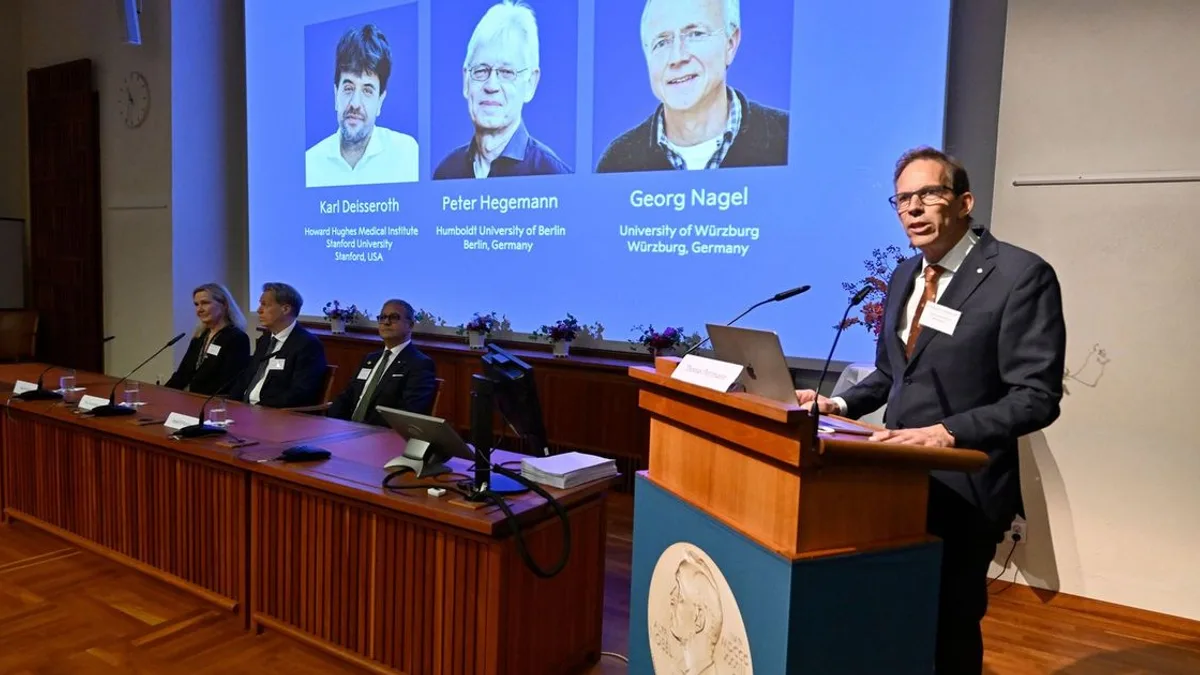
The Nobel Assembly at the Karolinska Institute in Stockholm announced on Monday, October 5, that the 2026 Nobel Prize in Physiology or Medicine goes to three scientists: American Karl Deisseroth and Germans Peter Hegemann and Georg Nagel. They were honored, according to the official citation, “for discoveries concerning light-gated ion channels and optogenetics.”
We published the Nobel week schedule yesterday, and these names open it.
What is optogenetics and why was it honored?
Optogenetics is a method that switches an individual nerve cell in a living brain on or off with light, with a precision of one millisecond. The Nobel Committee says it makes it possible to show how nerve cells shape memories, emotions and behavior. Laboratories around the world use it today.
Before it, mapping the brain was harder. Researchers in the 20th century tracked which brain regions affect which functions, but those methods could not prove cause and effect.
Per Svenningsson, chair of the Nobel Committee for Physiology or Medicine, said at the announcement:
“Optogenetics provides opportunities for mapping the brain in a way that we could once only dream of.”
What did Hegemann and Nagel find in an alga?
The story starts with a question about the single-celled alga Chlamydomonas: how does it manage to swim toward a source of light? Hegemann and Nagel, who made the discovery at the Max Planck Institute of Biophysics in Frankfurt, found the answer in a protein called channelrhodopsin. It is an ion channel in the cell membrane that opens when blue light hits it. Charged ions then flow into the cell and create an electrical impulse. They also showed that the protein works in any cell it is inserted into.
Sources disagree about when that work happened. Telegraf Nauka and Kurir place the discovery of channelrhodopsin at the start of the 2000s, while the American outlet STAT reports that the work at the Max Planck Institute began in the early 1990s, when Hegemann wondered how the alga swims toward light.
What did Deisseroth add?
Deisseroth put the channelrhodopsin gene into rat nerve cells and set off a nerve signal with blue light. He published the result in 2005, and two years later the method worked in the brains of living mice. That turned a protein from an alga into a switch for neurons.
He told STAT that light is usually used in science for observation, and that here it is the other way around: it is used to trigger events in cells. The call from Stockholm reached him after midnight, just as he was falling asleep, and he was the first of the three to be notified of the prize.
Thomas Perlmann, secretary general of the Nobel Assembly at the Karolinska Institute, relayed how the laureates reacted:
“I spoke with my three laureates this morning and all three were delighted. All three said the same thing, that it is wonderful to have received the prize together with the other two because they consider them friends.”
Who are the laureates and how is the prize split?
Deisseroth is a professor of bioengineering, psychiatry and behavioral sciences at Stanford University and at the Howard Hughes Medical Institute, and was born in 1971. Hegemann was born in 1954 and is a professor of neuroscience at Humboldt University of Berlin. Nagel was born in 1953 and is a professor of molecular plant physiology at the University of Wurzburg. Agency sources give different ages: Reuters says 54, 71 and 73, while STAT says 55, 72 and 73.
The prize is 12 million Swedish kronor, about 1.2 million dollars, split three ways. The medicine prize has been awarded 117 times, and 235 people have received it since 1901, 14 of them women. The youngest laureate was 31 and the oldest 87. Last year the prize went to Mary Brunkow, Fred Ramsdell and Shimon Sakaguchi for their work on how the immune system spares healthy cells.
Next up is Tuesday, October 6, when the physics prize is announced. Literature follows on Thursday, October 8, peace on Friday, October 9, and economic sciences on October 12. The prizes are presented on December 10.
What does this not prove?
The prize recognizes a method and discoveries that have already produced results in brain research, not a finished therapy. Early experiments were done on rat cells and in the brains of mice. Use in people, for example to restore sight in those with damaged vision, is only now being tested.