GS030: light sensitivity improved in 6 of 10 blind patients
The first human study of optogenetic therapy, in the New England Journal of Medicine, reports clinically meaningful gains in 6 of 10 participants but was not designed to prove efficacy.
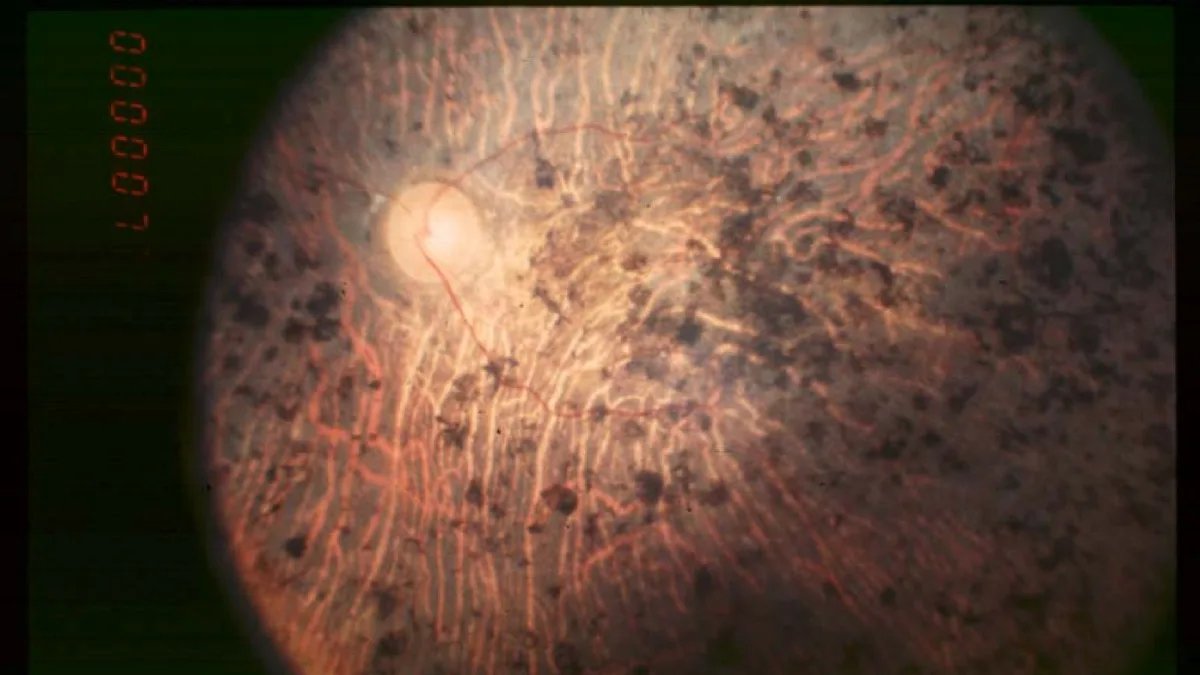
French company GenSight Biologics and the 15-20 National Hospital in Paris announced that the results of the first human study of the optogenetic therapy GS030 were published in the New England Journal of Medicine, in the October 8, 2026 issue. In 6 of 10 participants with late-stage retinitis pigmentosa, light sensitivity improved by a clinically meaningful margin. The study, however, was not designed to prove that the therapy works.
The paper, “Optogenetic Therapy for Restoring Aspects of Visual Function,” appeared a few days after the 2026 Nobel Prize in Physiology or Medicine was awarded to Karl Deisseroth, Peter Hegemann and Georg Nagel for their discoveries on light-activated ion channels and on optogenetics. The technique introduces a gene for a light-sensitive protein into nerve cells, so the cells begin to respond to light.
Retinitis pigmentosa is a group of inherited retinal diseases caused by mutations in more than 100 genes. Photoreceptors die off, vision declines irreversibly, and the first symptom is usually night blindness. According to the announcement, it affects about one person in 4,000, more than 1.5 million people worldwide, and most patients have no approved treatment.
How does GS030 bypass the dead cells?
The therapy is given as a single injection into the vitreous of the eye. An AAV viral vector delivers the gene ChrimsonR-tdT into retinal ganglion cells, which survive even after the photoreceptors die. The cells thereby become sensitive to light without the lost photoreceptors.
The protein is activated by strong amber light, so the patient wears GS030-MD optronic goggles. They convert the scene in real time into a beam of light of a specific wavelength and intensity and project it onto the treated retina.
What did the PIONEER study show?
PIONEER (NCT03326336) is the first use in humans: a phase 1/2, open-label, multicenter, dose-escalation trial. It enrolled patients with late-stage nonsyndromic retinitis pigmentosa who could not perceive light or barely could. Three groups of three patients received doses of 5e10, 1.5e11 and 5e11 vector genomes in the eye with poorer vision. After a safety review, the data safety monitoring board approved an extension group at the highest dose, which added one more patient, for a total of 10 participants.
Besides the 6 of 10 participants with better light sensitivity, four of the eight who completed behavioral tests did better with the goggles at spotting, locating or touching objects, or recognizing the position of a strip. High-density electroencephalography in some participants showed changes consistent with a signal reaching the visual cortex. The authors interpret this as a change in visual processing, not an artifact.
Most adverse events in the eye were mild or moderate. One severe event resolved within minutes after apraclonidine (Iopidine) drops, and no systemic event was linked to the drug or the injection.
Prof. Jose-Alain Sahel, founder and former director of the Vision Institute, said in a joint announcement that the results are an important step for optogenetics: “The results mark an important step in the development of optogenetics as an approach to restore vision”. The same announcement carries a caveat: “These results remain exploratory and will need to be confirmed and further investigated”.
Prof. Isabelle Audo, coordinator of the REFERET reference center at the 15-20 National Hospital, highlighted the value of collaboration between research teams: “This study also demonstrates the value of patient-centered clinical research”.
What does this not prove?
The sample is 10 people, and an open-label study has no blinding, so it cannot show that the improvement came from the therapy itself, or how long it lasts. The primary outcomes are safety and tolerability, while the vision results are exploratory. Follow-up runs for up to five years at centers in France, the United Kingdom and the United States, and the clinical assessment also involved the UPMC Vision Institute in Pittsburgh, Moorfields Eye Hospital in London and Streetlab. GS030 is not approved for sale in any country.