Marta Kos on Montenegro: accession treaty possible in 2027
The EU enlargement commissioner told Parliament's Foreign Affairs Committee that talks could technically end by early 2027, with signing next summer and membership in 2028.
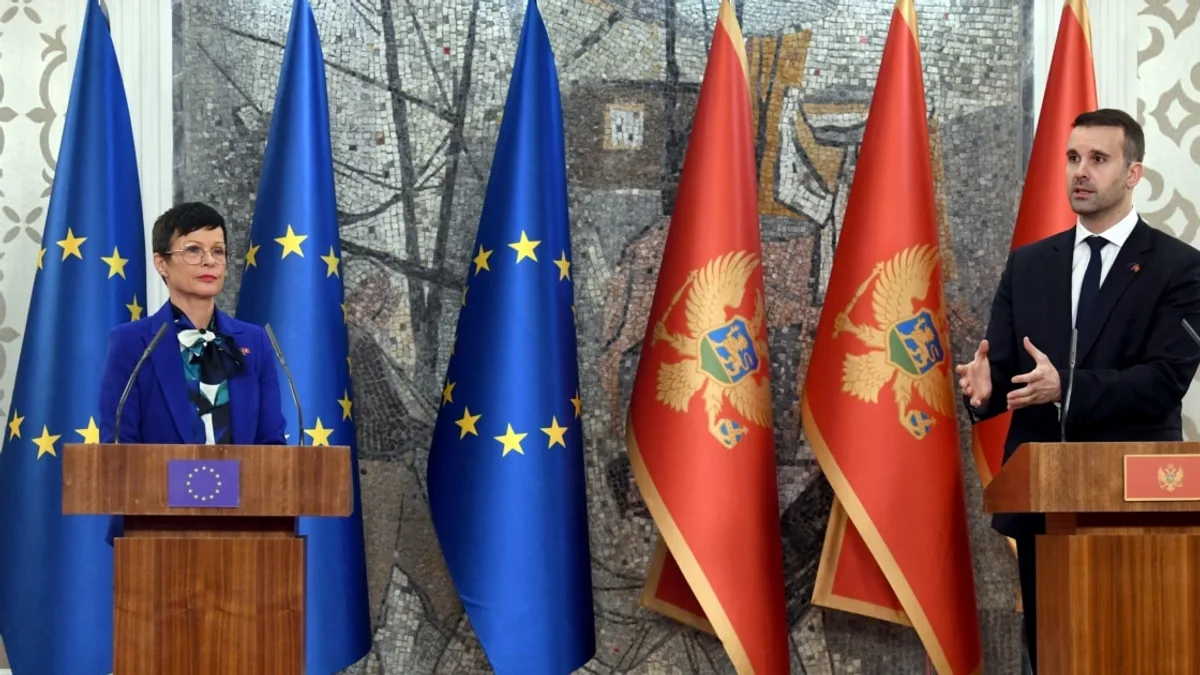
European Enlargement Commissioner Marta Kos told the European Parliament’s Foreign Affairs Committee (AFET) today that Montenegro’s accession treaty could be signed next summer, and that the country could become the EU’s 28th member in 2028. For Serbia, which is also a candidate and shares a border with Montenegro, it shows how quickly Brussels is counting on the most advanced candidate in the region.
What exactly did Kos say about the timeline?
The commissioner spoke in the conditional and listed the steps in order. According to Radio Free Europe, this is a possibility, not a date. RTCG, which reported from Strasbourg, says Kos presented the Commission’s new proposals to the members of the foreign affairs committee. Her words:
“When it comes to the timeline for Montenegro, we could finish the negotiations, or rather their technical part, by the end of this year or the beginning of next year. We are already preparing the accession treaty, which could then be signed next summer. Then comes the ratification process, which can take one to two years, depending on what happens in individual member states. That means Montenegro could become the EU’s 28th member in 2028.”
Ratification, then, stays in the hands of the member states, and their pace will decide whether 2028 is realistic. At the same session Kos also said she hopes the technical negotiations will be completed by the end of the year.
Where does Montenegro stand in the talks?
Montenegro has 18 of 33 chapters provisionally closed and still aims to finish the negotiations by the end of 2026. Kos summed it up at the session: “As you can imagine, Montenegro is at the end of the process.” The commissioner also repeated that on October 28, alongside the annual enlargement package, the Commission will present roadmaps for Montenegro, Albania, Moldova and Ukraine, RTCG reports. “The roadmaps will differ,” Kos said, and Radio Free Europe adds that they do not prejudge the outcome or the pace of the talks but serve as a basis for the work of the Council of the EU.
The political part will be on the table on October 15 and 16 in Brussels, at the summit of heads of state and government. The draft conclusions, which Radio Free Europe has seen, say the European Council welcomes the work on the accession treaty and notes the intention of the presidency of the Council of the EU to close all negotiating chapters by the end of the year.
Which new rules will Montenegro face first?
On October 6 the European Commission adopted a proposal for new rules for future members, and they will be applied for the first time to the treaty with Montenegro. According to RTCG, they include a 15-year transition period for serious breaches of the rule of law, and the option for a new member to give up its veto in bilateral enlargement disputes voluntarily, through a separate declaration outside the treaty itself. Kos stressed that all of this is legally grounded, and that monitoring of candidates will also be stepped up in the period between signing and ratification.
A message from Berlin
On the same day, German Foreign Minister Johann Wadephul posted a video on Instagram of a one-euro coin, with a message that several countries are missing from it and that this will now change for one of them, RTCG reported. In the post he wrote:
“A whole generation grew up with that promise. For one of those countries, EU membership is now within reach: Montenegro has good prospects of soon becoming the 28th member of the EU.”
He added that “whoever makes progress on reforms must also make progress in the accession process” and that “the EU must keep its word.” According to the same report, the minister noted that Montenegro has closed 18 of 33 chapters and is the clear front-runner among the six Western Balkan countries.