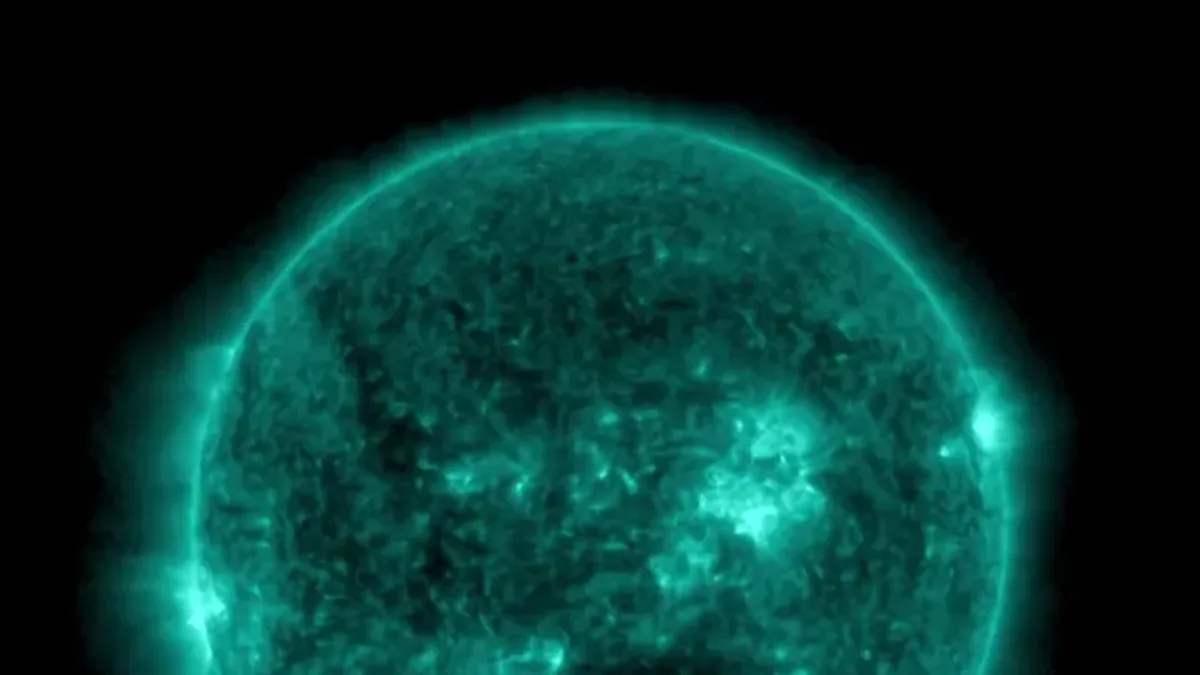
Geomagnetic Storm October 13: NOAA Forecasts Weak G1
The October 12 forecast calls for Kp up to 5.00 on Tuesday morning, driven by fast solar wind from a coronal hole. Parts of the same forecast disagree on which day G1 arrives.
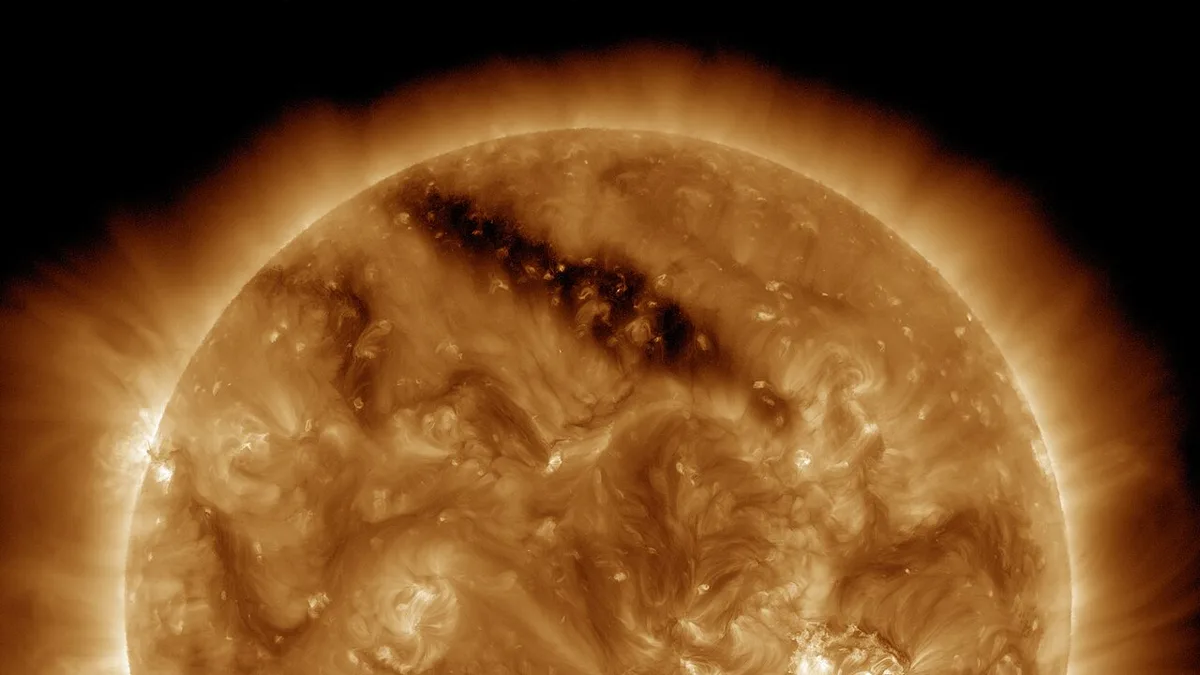
The Space Weather Prediction Center (SWPC) of the US agency NOAA issued a three-day forecast at 12:30 UTC on October 12, 2026, with a peak expected planetary index of Kp 5.00, which corresponds to a weak G1 geomagnetic storm. The peak is expected on Tuesday, October 13. The cause is not a new blast from the Sun but a fast stream of solar wind from a coronal hole, a dark region of the Sun’s atmosphere where the magnetic field is open to interplanetary space.
What does the forecast table show for October 13 and 14?
According to the table, the Kp index on October 13 rises to 4.67 between 03:00 and 06:00 UTC, then to 5.00 between 06:00 and 09:00 UTC, which is 5 to 11 a.m. in Serbia. NOAA labels both values G1. The index then falls, dropping to 2.67 by the end of the day. For October 14 the highest expected value is 4.00. Over the previous 24 hours the highest measured Kp was 3, below the storm threshold.
The center’s forecast discussion describes the same sequence. Early on October 12, conditions are quiet to unsettled as the effects of the October 10 storm fade. Late that day and overnight into October 13, active conditions are expected, with an isolated G1 storm that the discussion rates as likely for October 13. The fast stream from the negative-polarity coronal hole then moves into a position to affect Earth, and its influence weakens on October 14.
The starting point is already low. Solar wind speed has been falling steadily, from about 680 to about 465 kilometers per second at the end of the observed period. The total magnetic field of the wind averaged about 6 nanotesla, with a neutral vertical component, Bz, the one that decides how far Earth’s magnetosphere opens to incoming plasma.
Why do parts of the forecast disagree on the day?
The text of the same document does not give a single picture. One part of the rationale says G1 is expected on October 14, because of the coronal hole stream and a possible glancing blow from a plasma cloud. Another version of the rationale in the same document says a G1 or stronger storm is not expected. The table and the forecast discussion place G1 on October 13. Because the parts of the forecast do not agree, the only safe conclusion is that NOAA expects a boost around October 13, not that the storm will actually be reached.
The website Spaceweather.com writes of a watch for a G1 storm on October 13 and adds that the storm could grow to G2 if a coronal mass ejection also grazes Earth. According to that site, the cloud comes from an event on the Sun on October 10. In its discussion, NOAA mentions a glancing blow in connection with a filament eruption on October 11.
Where does the new plasma cloud come from?
Beginning at about 21:50 UTC on October 11, a long filament erupted northeast of the southern coronal hole. The associated ejection was first seen in LASCO C2 coronagraph images at 23:00 UTC and in CCOR2 images at 23:30 UTC. NOAA says modeling shows most of the mass will pass behind Earth’s orbit, with a small chance of a mild glancing blow, which the forecast places on October 14.
The discussion adds that further enhancement of the interplanetary magnetic field is possible on October 13 from an ejection logged as the October 11 cloud, and on October 14 from the cloud after the filament eruption, but with low confidence. Estimates of this kind change with every new analysis of the images.
How does the Sun look after the G3 storm?
The October 10 storm reached level G3 when two nearby plasma clouds merged on their way to Earth. Spaceweather.com calls this merger a “cannibal” ejection: the faster cloud catches up with the slower one and pushes it ahead. Plasma density exceeded 100 protons per cubic centimeter, and the aurora was seen across Europe. Across the Atlantic the effect was far weaker. Jessica Fridrich sent the site a photo from Duluth, Minnesota, and said: “The US only got crumbs this time.” She added: “The magnetosphere was so disturbed that even the crumbs were still pretty nice.” We described the impact in our earlier report on the G3 storm and the M6.4 flare.
Since then the Sun has been noticeably calmer. The strongest flare in the past 24 hours was a C1.2 from region 4545 (N17W79) on October 11 at 17:01 UTC. Region 4549 (N09W75), which, as we reported, produced the M6.4 flare, keeps a weak delta configuration (class Dao, beta-delta), but it is nearing the western edge of the disk, so classifying it is getting harder. Region 4551 (S14E41, class Eko, beta) has simplified and is mostly quiet, as is region 4553, while a new one, 4554, has been numbered east of it.
The probability of an R1 to R2 radio blackout is 55 percent for October 12, 50 percent for October 13 and 45 percent for October 14. For R3 or stronger the figures are 15, 10 and 5 percent. NOAA ties the flare probability mostly to region 4549, which is rotating off the disk. An S1 proton storm remains unlikely (10, 5 and 5 percent by day), and the electron flux above 2 MeV should rise to high levels on October 13 and 14.
What this forecast does not prove
The Kp in the table is a forecast, not a measurement, and its three parts have not yet been reconciled on the day G1 could arrive. Nothing in it shows that the storm will reach Kp 5, or that an aurora will be visible from our latitudes. NOAA itself cites low confidence in the additional enhancements, and the actual course of October 13 and 14 will be shown only by satellite measurements. The forecast has already fallen short once: on October 10, the predicted G2 turned into a G3.